
Ask five nonprofit executive directors what keeps them up at night, and you’ll likely hear variations on the same theme: “We’re being asked to do more with a team that’s already running on fumes and funding that always comes with strings attached.” While the industry’s headline numbers look fine—total giving hit a record high in 2024—the lived experience inside most nonprofits tells a different story. This article explores why scaling a nonprofit is harder than it looks, and what leaders can do about it.
Key Takeaways
- Nonprofit growth involves balancing revenue diversification, donor retention, staff stability, and infrastructure investment.
- Despite record levels of giving, nonprofit revenue is concentrated among fewer, wealthier supporters, and donor counts continue to fall.
- Government funding disruptions hit many nonprofits in early 2025, forcing them to accelerate revenue diversification plans.
- Donor retention delivers better returns than acquisition, making stewardship an important growth investment.
- Technology investments that focus on integrating donor, program, and financial data can propel nonprofit growth.
Why Is Nonprofit Growth So Challenging?
Nonprofit leaders hear plenty about growth plans, but fewer discussions focus on why scaling is difficult for the industry. Lean budgets are an obvious issue, but the challenges below go beyond money. Stifled growth is stitched into the fabric of how nonprofits operate, from how they define success and build capacity to how they raise funding and balance competing priorities.
Growth in the Nonprofit Sector Is Multidimensional
For-profit companies can define growth in relatively simple terms: revenue, profit, and market share. Nonprofits don’t have that luxury. For example, a food bank might define growth by the number of meals distributed, families served, volunteer hours, donor retention, and operating reserves—all at once. But these KPIs don’t always move together, and boards may push for one definition of success while funders expect another.
Demand Often Outpaces Infrastructure
When a crisis hits, nonprofits face immediate pressure to expand services, but expanding without the systems to support it breeds burned-out staff, drops in service quality, and donor dissatisfaction. The Nonprofit Finance Fund’s “2025 State of the Nonprofit Sector” survey found that 36% of nonprofits ended 2024 with an operating deficit—the highest rate in 10 years—and 85% expected demand to rise further in 2025.
Challenges With Evaluating Growth Against Outcomes
Funders increasingly expect nonprofits to demonstrate measurable impact, but building the data infrastructure to track outcomes requires investment that restricted grants rarely fund. Organizations with the resources to invest in outcome tracking—such as dedicated evaluation staff or integrated databases—can make a stronger case to funders, which attracts more funding and pays for better evaluation. Those without that capacity can struggle to make their case to funders, even when their programs work.
Overcoming Donor Assumptions About Overhead Costs
The “overhead myth”—the belief that low administrative costs signal organizational virtue—has weakened but hasn’t disappeared. This creates a real dilemma, because growth requires more overhead: more staff, upgraded technology, and increased administrative capacity. Many donors still expect funding to go directly to programs without a corresponding rise in operational costs, ignoring the reality that long-term growth demands investment in the organization itself.
Pursuit of Growth Can Cause Mission Drift, Competing Priorities
Sometimes growth opportunities don’t fit the mission—and pursuing them can do more harm than good. A children’s literacy nonprofit might chase a grant for adult job training simply because the money is available. A shelter might accept a corporate sponsorship from a source that doesn’t fully reflect its values. It’s tough to pass up funding, especially when budgets are tight, but each “yes” accumulates and over time can push a nonprofit far from its original purpose. In other words, what looks like growth on paper risks becoming fragmentation in practice.
7 Tips for Scaling in the Nonprofit Sector
Although there are challenges, plenty of nonprofits do grow sustainably. The organizations that succeed diversify how they bring in revenue, invest in capacity before they desperately need it, treat donor relationships as long-term partnerships rather than transactions, and are typically disciplined about which opportunities to pursue.
-
Align Growth Objectives With Mission and Values
Growth for its own sake rarely works out well for nonprofits. For instance, chasing grants outside your expertise or adding programs just to boost revenue will stretch your team thin and pull focus from the work you do best. Before seeking expansion, ask yourself if the opportunity furthers your core mission. Are you equipped with—or can you build—the capacity to execute it? The discipline of saying no to misaligned opportunities, even well-funded ones, protects organizations from the slow accumulation of commitments that leads to mission drift. And when your mission gets fuzzy, so does your case to funders—it’s harder to attract long-term support when you can’t point to a clear impact.
-
Diversify Revenue Streams
Government funding is a lifeline for many nonprofits. But in early 2025, one-third experienced disruptions to that funding—a reminder of the risk that comes with overrelying on any single source of revenue. Diversification, on the other hand, emphasizes revenue consistency and development, including earned income, repeat donors, grants, corporate partnerships, and planned giving. But therein lies a predicament. Diversification demands infrastructure: staff to cultivate donors, systems to track grants, expertise to manage corporate partnerships. That all costs money, and, as the overhead myth persists, many donors remain reluctant to fund.
-
Deepen Existing Donor Relationships
The Fundraising Effectiveness Project found that only 19% of first-time donors gave again in 2025. On the bright side, 59% of repeat donors gave again in 2025. The implication is that nonprofits should invest more in donor management and stewardship programs.
Technology can help stewardship become proactive. AI-powered donor analytics, for instance, can flag at-risk supporters before they lapse, giving development teams a chance to intervene with personalized outreach. Some platforms are able to analyze engagement patterns by touchpoint—email opens, event attendance, giving frequency—to predict which donors are likely to upgrade and which need re-engagement.
Monthly giving programs also present an opportunity. Monthly donations accounted for 27% of all nonprofit online revenue in 2025, and monthly donors stick around longer: 71% are still giving after a year, compared to 24% of first-time, one-time donors.
-
Encourage Staff Training and Career Development
Staff churn is a silent drag on nonprofit growth. Every departure costs money and momentum, and the remaining staff absorbs extra work until the role is filled. A 2025 study by The Urban Institute found that 72% of nonprofits nationwide said job vacancies negatively affected their ability to pursue their missions. So it should come as no surprise that 7 in 10 nonprofit employees in a separate 2025 study said they’d be looking for a new job. But going on a hiring spree won’t fix the problem. What will? Competitive compensation, professional development, clear advancement paths, and workplace cultures that prevent burnout.
-
Evaluate the ROI for Different Fundraising Activities
The ROI on nonprofit fundraising differs by activity. For example, galas are great community-builders but often cost more than nonprofits realize when staff time is fully accounted for. Digital campaigns acquire donors at a lower immediate cost, but those donors may not stick around without dedicated follow-up. Evaluating ROI means tracking the full cost per dollar raised, including staff hours, and comparing retention rates across channels. That helps gauge which activities deserve ongoing funding and which should be scaled back—giving staff more time for higher-ROI work.
-
Consider Partnerships With Other Organizations
Growth isn’t always about adding programs and staff. The Sustained Collaboration Network found that 73% of nonprofits that collaborated through mergers, shared programs, or joint initiatives achieved measurable growth. But partnerships fail when enthusiasm outruns capacity. The best ones start small, with a shared project that tests the fit before either side commits to more.
It also helps that funders are increasingly willing to cover the legal and integration costs that once made collaboration impractical.
-
Invest in Infrastructure That Enables Efficiency
Technology has been woefully underfunded at most nonprofits—a casualty of the overhead myth and tight budgets that prioritize programs over infrastructure. But inefficiency has its own price. Every hour spent on manual data entry or reconciling disconnected systems is an hour not spent on mission-focused work. Integrated cloud-based platforms, such as ERP systems, create smoother, automated workflows and build a foundation for predictive data analysis and real-time financial reporting. Platforms with embedded AI take this further, automating routine reconciliations and flagging exceptions before they require human intervention.
How the Right Software Enables Nonprofit Growth
Here’s a familiar scenario for nonprofits: Donor records are in one database, program data in another, financials in a third. So when a board member asks how much it costs to serve each client, the answer involves pulling exports into a spreadsheet—a process that’s slow and error-prone, yet often accepted as just how things work. Making matters worse, the month-end close drags on because reconciling across multiple systems demands soul-crushing amounts of manual work.
Not so with integrated platforms like ERP systems that connect the data nonprofits actually need—donor records, gift history, program enrollment, grant obligations, fund balances, and financials—in one place. When a donation comes in, the system automatically updates the donor record, posts revenue to the correct fund, and sends an acknowledgment note.
AI capabilities embedded in these platforms can interpret this data, too. When a major donor’s engagement drops or a grant deadline approaches, AI-powered alerts can flag the situation before it becomes a crisis. Month-end processes that once required finance staff to comb manually through transactions can be monitored continuously, with AI highlighting anomalies for review. This saves teams from that last-minute crunch.
What’s more, nonprofits have unique reporting demands. They need to see fund balances by restriction type, cost per outcome by program, and compliance status by grant. Systems built for commercial businesses often lack the architecture to deliver all that, which is why the ideal platform is one designed specifically for nonprofits—one that is capable of handling split allocations, deferred revenue on multiyear pledges, and reporting that satisfies both GAAP and funder-specific guidelines.
Track Nonprofit Growth With NetSuite
Scaling a nonprofit requires visibility into finances, donors, programs, and operations. When those data streams run through separate systems, leaders reach decisions based on incomplete information. NetSuite for Nonprofits brings them together on a single cloud platform built to handle the complexity of managing nonprofit operations.
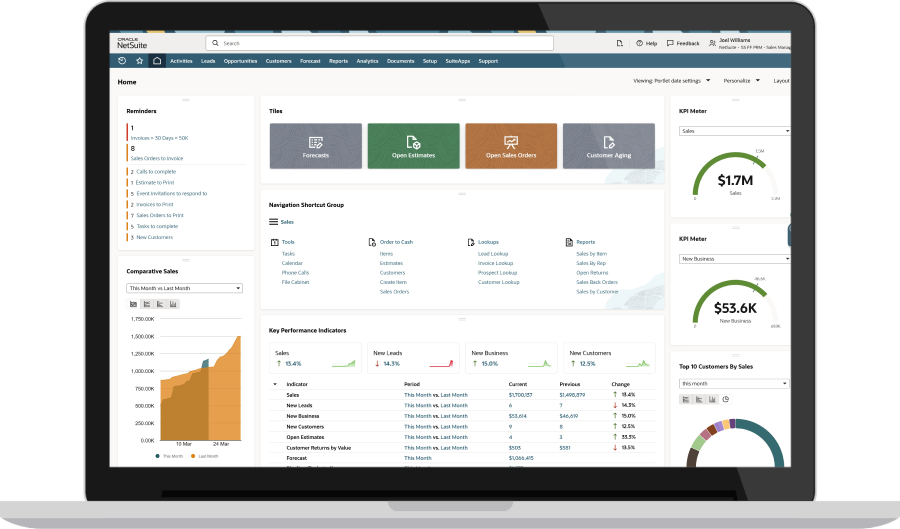
Fund accounting tracks restricted and unrestricted revenue by grant, program, or campaign, so finance has real-time views into fund balances and compliance status. NetSuite’s constituent relationship management module consolidates donor records, engagement history, and giving patterns, thanks to AI-powered analytics that can flag changes in donor behavior before they become retention problems. NetSuite SuiteAnalytics Reporting & Dashboards lets leadership track donor retention rates, program costs per outcome, cash reserves by fund, and other key metrics in real time, rather than having to glean the information from quarterly reports. And when month-end rolls around, NetSuite’s autonomous close capabilities monitor transactions throughout the period, flag exceptions, and propose resolutions before the close becomes a scramble.
NetSuite Nonprofit ERP Dashboards
The raise-more-spend-more playbook has run its course. What’s working for nonprofits now is less dramatic but more durable growth efforts: multiple revenue streams, workforce sustainability, deeper donor relationships, infrastructure that’s in place before it’s urgently needed, and the discipline to say no to opportunities that dilute the mission.
Nonprofit Growth FAQs
Should nonprofits focus more on donor acquisition or retention?
Retention usually delivers better returns. As a general rule, the cost of replacing a lapsed donor exceeds the cost of keeping an existing one engaged, suggesting investment in stewardship could be particularly valuable.
How important is technology in nonprofit growth?
Technology’s importance is definitely growing. Nonprofits with integrated systems spend less time on manual work (think: data entry and reconciliation), allowing staff to focus on mission-focused work. Consolidated platforms also provide the crucial data quality needed for donor analytics, financial planning, and impact measurement. As AI capabilities mature, these platforms increasingly handle routine monitoring and exception-flagging automatically.