
The consulting industry’s model for selling expertise has worked well for decades: A client has a problem, a firm sends smart people to study the client’s situation and its data and then plot its route forward. Now, artificial intelligence is making it necessary for consultants to rethink their playbook.
Generative AI tools can absorb and interpret research in minutes, draft deliverables overnight, and perform scenario-testing faster than human analysts. This change has consulting firms reassessing everything: how they staff projects, price engagements, and solve problems—and what “expertise” even means when a machine can produce a first draft. Change is affecting every corner of the industry, from global consulting powerhouses to boutique specialists, and it is happening fast.
How Is AI Changing the Consulting Sector?
In almost every industry, AI’s most significant early benefit is saving time. In consulting, projects that take junior analysts days, such as in-depth research or competitor benchmarking, can be completed in hours with AI’s assistance. That compression has a domino effect. Project schedules shrink, and clients expect faster turnarounds. The “leverage model,” in which many junior analysts do production work and a few seniors analyze their results and build strategy, no longer makes economic sense. Firms are responding in several ways.
First, they’re moving senior consultants closer to the work. In other words, when AI manages the time-consuming work, clients start interacting with senior advisors earlier in engagements. Second, firms are building reusable tools and assets. Rather than starting over with each client engagement, they’re packaging templates, agent workflows, and industry playbooks that can be repurposed with other clients. Third, they’re rethinking talent. The “Excel and PowerPoint factory” portion of early consulting careers is shrinking, leading firms to redesign junior roles toward less production and more judgment.
This isn’t only about speed. It’s about shifting the point at which human value contributes to the consulting equation. The more analysis itself becomes a commodity, the more clients are paying for the judgment, trust, and expertise needed to act on recommendations.
Emerging AI Technologies in the Consulting Industry
A handful of AI technologies is reshaping the consulting industry. These technologies affect how work gets done but often do so in different ways.
AI Agents
AI agents perform multistep work with minimal human hand-holding. During merger-and-acquisition due diligence, for instance, an AI agent can scan hundreds of filings and articles, pull key data into a table, and flag risks for a consultant to review. Firms keep these tools focused on well-defined tasks and have human consultants approve all outputs before they reach clients.
Explainable AI (XAI)
XAI refers to tools and methods that show how AI models reach their conclusions. Certain techniques, such as Shapley additive explanations and local interpretable model-agnostic explanations, pinpoint the inputs behind a particular output, turning a black-box prediction into something potentially auditable. This matters most in regulated industries, where clients may need to explain AI-influenced decisions to a board or regulator.
Generative AI
Consultants first used GenAI as a drafting tool for documents and presentations, but its use cases have moved beyond that. The most powerful examples involve testing scenarios quickly. Teams can work through large bodies of research and map findings to standard strategy frameworks. Some firms are launching interactive products and tools—knowledge bases, copilots, dashboards—that clients continue using after the engagement ends.
RPA and BPA
Robotic process automation (RPA) handles repetitive, rule-based tasks, while business process automation (BPA) automates entire workflows, sometimes involving multiple departments. Before GenAI burst onto the scene, RPA and BPA were already shifting consulting toward process-led work and managed services. Adding AI expands what automation can do. Some predict AI agents will eventually replace RPA for complex tasks, though the two will likely coexist: agents will handle dynamic decisions, while RPA continues to manage repetitive actions on legacy systems. Process-mining combined with GenAI can turn logs, tickets, and interviews into process maps faster than manual workshops. And AI can handle semi-structured content, including emails and PDFs, that previously broke RPA workflows.
Impacts of AI in the Consulting Industry
AI is changing the skills consultants need, how firms make money, and much in between. This includes:
- Reshaping consultant skills: In the age of AI, consultants need new skill sets. Crucially, they must develop AI literacy—namely, understanding what models can and can’t do and how to get useful outputs from them. At the same time, human skills, such as judgment and client trust-building, are becoming more valuable.
- Development of new service models and tools: Growth is strongest where firms bundle advisory services with implementation and managed services, with AI automating workflows so consultants can focus on strategy. The shift has created new service lines. AI governance and operating model design are now standard service lines, and AI-powered workforce transformation has become its own practice area.
- Increased efficiency: AI slashes the time it takes to produce first drafts. But big gains also come from faster iterations on tasks ranging from the straightforward, such as a consultant testing five versions of a financial model; to the complex, such as running staffing scenarios that balance skills, availability, and utilization, and development goals.
- New career paths: Firms are redesigning junior roles as the production-heavy portion of early careers shrinks. Firms are also creating positions that didn’t exist a few years ago, such as AI product owners that manage internal tools. Some have hired prompt engineers and evaluation leads to support delivery teams.
- Enhanced insights: AI data analysis lets consultants pull from larger bodies of information and test more hypotheses in less time. The old constraint was volume: “How much can we process?” The new one is verification: “How do we know it’s right?”
How AI Is Being Used in the Consulting Sector
Consulting firms aren’t just advising clients on AI—they’re building their own tools and deploying them at scale. The following examples illustrate how midmarket firms are putting AI to work.
SIB’s Cost Reduction Agents
Charleston, SC-based SIB is a cost-savings consultancy that uses AI agents to find savings in fixed costs, such as telecom, utilities, and software licenses. The agents monitor invoices, vendor contracts, and billing patterns, seeking discrepancies for consultants to review and act on. SIB operates on a contingency model: If they don’t find savings, they don’t get paid. The firm has identified more than $8 billion in cost savings since launch and serves clients ranging from Kroger and Marriott to San Diego County.
Keystone Strategy’s Operational AI
Keystone, a technology and economics consulting firm co-founded by a Harvard Business School professor, focuses on operational AI. While many firms use AI to draft documents or summarize research, Keystone builds AI into core business functions, such as supply chain management, inventory optimization, pricing, and forecasting. In January 2026, the firm spun off Keystone.AI as a separate company dedicated to AI-powered forecasting and decision-making for manufacturing supply chains. Keystone’s client roster includes Oracle and Intel.
Genpact’s Client Zero Initiative
Genpact, a professional services firm, takes an “eat your own cooking” approach to AI. The company launched Client Zero, an initiative to design, test, and refine AI solutions internally before rolling them out to its 800-plus clients. The program spans HR, finance, IT, and legal functions, with the goal of building prototypes for what Genpact calls “functions of the future.” One result is AI Maestro, an orchestration layer that coordinates human and digital agents using process intelligence from more than 1,000 AI models.
Considerations and Challenges
AI adoption in consulting comes with real risks that firms must actively manage. Here are the most common:
- Hallucinations and hidden errors: This is the most immediate concern for consultants. Generative models can sound confident despite incorrect facts or incorrect logic. Without careful review, a polished deliverable can mask weak reasoning.
- Data security and confidentiality: AI raises serious questions about security and confidentiality. Clients worry that sensitive information might leak via prompts or vendor logs, and they want to know how models are trained on their data. Firms are responding with detailed data-handling protocols, such as private, air-gapped LLM instances for secure client-specific document analysis. Some are also specifying which tools can access client information and which can’t.
- Fairness: This has emerged as a sensitive issue when AI shapes recommendations affecting people. HR decisions, such as hiring, are obvious examples; a model could screen out qualified candidates. The same concerns apply in lending and insurance, where a model’s output can determine whether a person or business is approved or denied.
- Skills gap: Upskilling an entire consultancy to be AI-literate is a major challenge, even before you count the universal shortage of AI-skilled professionals. Demand for AI talent exceeds supply by more than 3-to-1, and most firms can't simply hire their way out of the gap.
- Overreliance and deskilling: This is a subtler risk. If teams become dependent on AI for analysis, they may lose the ability to do first-principles work when the technology fails or when a situation falls outside its capabilities.
- Infrastructure costs: Nontrivial investment is required to support AI adoption. Private LLM instances, data pipelines, orchestration layers, and governance controls all add up—and firms that want air-gapped or firewalled environments for client work face even higher costs.
- Agentic AI security: AI agents introduce new attack surfaces that security tools haven’t caught up with. Prompt injection, privilege escalation, and data exfiltration are active concerns, and nearly half of security professionals surveyed expect agentic AI to become a top attack vector by year’s end.
Firms are settling on a practical governance approach. Policies define acceptable use and client-consent requirements. Processes require human review and documentation of assumptions. Technology safeguards include logging, monitoring, evaluation guidelines, test suites, and quality scorecards. Liability and ethics matter, too. AI can build recommendations, but the firm must still defend those recommendations to clients, regulators, and boards. Accountability can’t be delegated to a model.
An AI-powered ERP Solution for Consulting Firms
Consulting firms juggling client work, internal operations, and AI adoption face a coordination challenge. Project data lives in one system, financials in another, client records somewhere else. When information is scattered, teams spend time hunting for answers instead of delivering value.
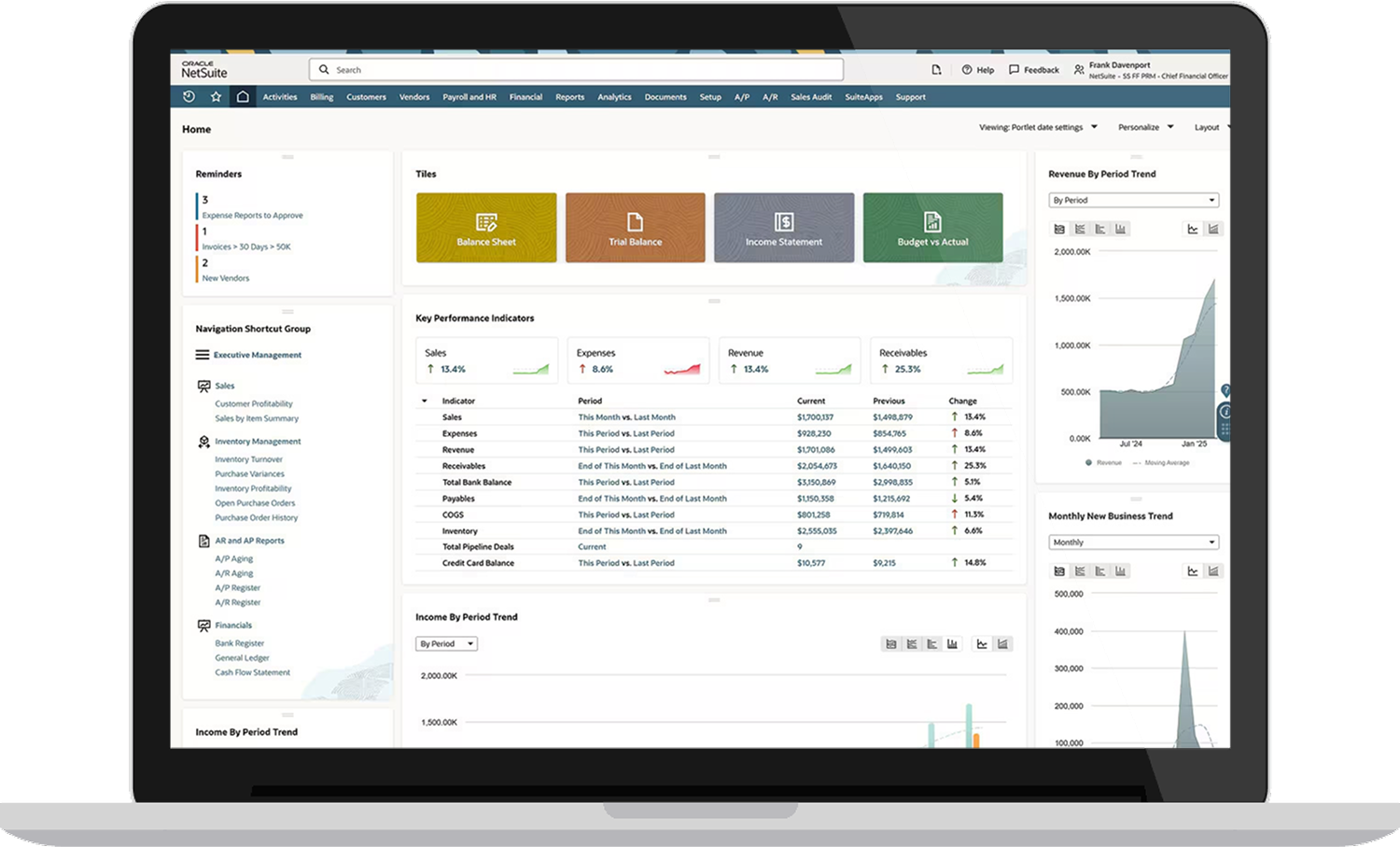
NetSuite ERP for Consulting Firms connects project management, financials, customer relationship management, and analytics in a single system that gives consulting firms a unified view of engagements, resource utilization, and business performance. SuiteAnalytics supports custom dashboards for tracking metrics, such as project profitability and utilization rates. NetSuite OneWorld handles multiregional operations, covering different currencies and regulatory requirements. The platform also embeds AI directly into workflows, incorporating features like intelligent bill capture and automated transaction matching to reduce manual work and flag exceptions.
AI is changing how consulting firms operate, compete, and deliver value. The best-positioned firms will be those that combine AI-enabled speed with the human judgment, trust, and accountability that clients rely on. That takes more than adding new tools: It requires rethinking talent models, governance frameworks, and the understanding of what a consulting engagement looks like. The technology will keep evolving—consulting firms must evolve with it.
AI in Consulting FAQs
Is AI going to replace consulting?
No. AI is changing the kinds of tasks consultants perform, not eliminating the need for trusted advisors. Work involving judgment, stakeholder alignment, and accountability for high-stakes decisions has so far resisted automation. What’s shifting is where human value sits in the equation: less time on production, more time on interpretation and decision-making.
What are the main benefits of using AI in consulting?
AI accelerates research and analysis, so consultants can synthesize more information and test more scenarios in less time. It reduces the manual effort necessary for documentation and deliverable production and opens the door to new service offerings, such as AI governance advisory and reusable diagnostic tools. The net effect is faster delivery, broader analysis, and new revenue streams.