
On the surface, rising assets and revenue suggest a wealth management business is healthy and growing. But those numbers can be misleading. Assets might pour in because markets are rising, not because the firm is winning new business. Or revenue may climb at the same time fee pressures are squeezing margins. To separate growth that looks good on paper from organic growth driven by internal strengths, wealth management businesses must keep a close eye on multiple key performance indicators (KPIs) simultaneously. These include the clients they attract and retain, advisor productivity, the cost of earning and serving clients, and whether revenue is strengthening the business.
Key Takeaways
- No single KPI tells the whole story, which is why wealth management firms should track three KPI categories: executive, growth, and operational.
- Executive KPIs measure the firm’s overall financial health, including its assets, revenue, profit per client and advisor, and client retention rate.
- Growth KPIs indicate how effectively the firm attracts new clients and assets and turns those relationships into sustainable growth.
- Operational KPIs show how efficiently the firm serves clients and whether it has the capacity to support future growth.
- A host of technologies, including CRM and ERP platforms, as well as AI, help wealth management firms detect inefficiencies and make better business decisions.
Why Wealth Management KPIs Matter to Firms
KPIs provide wealth management firms with a consistent way to assess what’s working, identify where they’re creating value, and spot areas for improvement. Some KPIs, such as assets under management, revenue, and profitability, provide a high-level view of the business, while others, such as net new clients and average client tenure, provide more granular insight into the factors driving those results.
The right KPIs help connect the dots, illustrating a company’s performance and helping leaders see whether growth is leading to stronger client relationships, greater advisor productivity, and ultimately a more valuable business. This level of visibility is increasingly important as wealth management firms face more pressure to grow efficiently. According to PwC, 89% of asset managers report an increasing push for profitability amid greater competition, fee pressure, and rising operational expenses—despite rising global asset and wealth management revenues.
18 Major Wealth Management KPIs
Evaluating the economics of client relationships, advisor and team productivity, organic growth, operating efficiency, and how different segments perform creates accountability and gives decision-makers a sound basis for setting priorities. The following 18 KPIs fall into three categories—executive, growth, and operational—which together reflect how well the business is performing.
Executive KPIs
Wealth management leaders need to know whether a firm is winning and retaining clients, attracting new assets, converting growth into revenue, and operating efficiently. These seven executive KPIs shed light on a firm’s overall financial and operational performance:
- Net new assets (NNA): A positive NNA indicates a firm attracted more assets from clients than it lost through withdrawals. How much money clients add over a specific period is one of the clearest measures of organic growth, which is the firm’s ability to create added value internally rather than through market performance-related changes in asset values or spending on external growth strategies.
- Client retention rate: The percentage of clients who remain with a wealth management firm over a specified period is an indicator of stability. When clients leave, they take current revenue, future referrals, and expansion opportunities with them, and replacing them requires costly marketing, sales, and advisor time. A sudden decline in customer retention can signal service problems or client dissatisfaction.
- Total assets under management (AUM): AUM—the market value of the assets a firm manages on behalf of its clients—remains one of the most recognizable measures of a wealth management firm’s size and scale. Many companies charge fees based on a percentage of assets, with a larger asset base generally creating a larger pool of recurring fee revenue. AUM can rise because of market appreciation, rather than new business, which is why executives typically examine it alongside NNA.
- Total revenue: The overall amount of money a wealth management business generates from its operations, including advisory fees, asset management fees, planning fees, and commissions, is a starting point for evaluating profitability. If revenue increases 20% but operating expenses rise by 25% during the same period, profit will lag. That’s why executives typically evaluate total revenue alongside expense and profitability metrics.
- Revenue growth rate: Determining whether a business is generating more revenue than it did previously—typically compared year over year—is a direct measure of financial performance and is often evaluated alongside AUM growth. If AUM increases 15% but revenue grows only 5% one year to the next, fee compression, a shift toward lower-fee products, or a change in client mix could be taking a toll on revenue growth.
- Net profit per advisor: The average amount of profit the firm generates per advisor is a useful window into advisor productivity and the firm’s operating efficiency. It’s especially relevant as wealth managers look for ways to serve more clients amid a looming talent gap of about 100,000 advisors by 2034, according to McKinsey. Team-based service models and AI-enabled workflows can help advisors serve more clients, creating opportunities for firms to improve profitability per advisor.
- Net profit per client: Calculating how much profit the firm earns from each client after accounting for the associated advisory service costs helps businesses identify the value of client relationships. By evaluating the profitability of different client segments, managers can determine how much to invest in handling each one. Clients generating high net profit might justify a high-touch service model with frequent advisor meetings and customized financial planning, while smaller investors may be satisfied with fewer one-on-one meetings and greater use of digital tools.
Growth KPIs
Growth KPIs determine whether wealth management firms are attracting new clients and assets, and how efficiently and sustainably they are growing. These metrics can reveal whether growth comes from a strong client experience, productive advisors, effective marketing, or simply favorable market conditions.
- Net promoter score (NPS): How likely clients are to recommend a firm to someone they know is a useful snapshot of client sentiment. The average wealth management firm earns an NPS of 40, according to Bain, and higher scores are considered even stronger. Over time, a rising NPS can signal improving client satisfaction, while a declining score may warrant taking a closer look at advisor relationships and service quality.
- Referral rate: The percentage of clients who come through referrals is a key organic growth metric for relationship-driven wealth management firms. A high referral rate suggests that a firm’s client experience translates into solid business development—potentially reducing spending on advertising or purchasing leads.
- AUM per advisor: The average amount of client assets managed by each advisor is an indicator of advisor productivity and the firm’s ability to grow. A higher figure is not necessarily better, however, since complex clients may require more time and attention. Technology and other service model improvements can allow advisors to manage larger books without adding headcount.
- Net new clients: The number of client relationships the firm adds, minus the number who leave, is a straightforward measure of whether the client base is growing. However, this metric doesn’t necessarily reflect the amount of new business; it depends on whether the firm is bringing in profitable clients. This KPI is more useful when viewed alongside NNA and AUM because adding many small investors might increase client count without substantially changing the firm’s assets.
- Expense ratio: Measuring the firm’s operating expenses as a percentage of revenue shows how much of every dollar earned goes toward running the business. A declining expense ratio can reflect greater efficiency as the firm grows, perhaps because the business is increasingly using AI to automate routine tasks and support advisors.
- Client acquisition cost (CAC): CAC measures how much a wealth management firm spends to acquire a new customer by assessing the cost-effectiveness of different sales and marketing channels. But cost alone does not determine a channel’s value. A more expensive channel may attract clients who generate more revenue and remain with the company longer. Firms should therefore weigh CAC against the long-term value of the clients each channel produces.
Operational KPIs
Operational KPIs help wealth management firms assess whether they can grow without overloading their advisors or detracting from the client experience. Examining whether advisors have enough capacity to take on new clients or whether the firm is spending too much time on certain relationships can identify problems that affect client satisfaction.
- Client growth rate: Tracking how quickly a firm’s client base is increasing helps wealth management firm leaders determine whether the business can meet demand while maintaining service quality. For example, monitoring client growth over a given period can reveal whether the company’s staffing and technology are keeping pace with a growing client base.
- Average client tenure: How long clients typically remain with a firm reflects the stability of customer relationships—and longer tenures often translate into greater lifetime value. Tracking this KPI by client segments—for example, by wealth tier—helps firms identify their strongest relationships and target retention efforts where they’re needed most.
- Time spent per client: Measuring how much time advisors and staff devote to each client helps determine whether that investment is justified by the revenue the relationship generates. This includes tracking time spent in meetings, preparing financial plans, responding to questions, and handling administrative tasks. When serving a client takes more time than the relationship’s value, firms can turn to AI agents and other technology to handle routine tasks.
- Total number of clients retained: Counting how many clients remain with a firm over a period of time provides a concrete, ground-level view of client stability—distinct from the retention rate, which measures proportional performance. By breaking this KPI down by advisor, office, or client segment, firms can identify where client departures are concentrated and diagnose any underlying service or relationship issues.
- Next-generation client retention rate: With a large amount of wealth expected to pass between generations in the coming years, firms risk losing assets if their clients’ heirs move inherited investments to another provider. A strong next-generation retention strategy may involve building relationships with heirs long before a wealth transfer.
Monitoring Wealth Management KPIs With Software
Software helps wealth management firms monitor KPIs continuously and spot changes in real time. A well-designed system can warn when a metric moves outside an expected range and pinpoint which advisors, client segments, or offices are responsible for shifts in retention, revenue, or profitability. This is where CRM software for wealth management can play an important role by tracking client-facing KPIs, such as retention, referrals, NPS, and advisor activity. A CRM dashboard brings the data together so managers can see which advisors are meeting growth and retention targets and determine which client relationships need attention. An ERP system extends those capabilities by capturing financial and operational KPIs. Connecting their CRM and ERP software ultimately lets firms see whether stronger client relationships translate into a healthier business.
In addition, AI helps wealth management firms identify patterns, such as an uptick in time spent per client without a corresponding rise in revenue. AI detects when a KPI changes, then suggests reasons for the shift and what to do about it. It can also pick up on client life events that KPIs alone don’t capture, such as an approaching retirement or an intergenerational wealth transfer. Agentic AI takes defined actions based on this analysis. For example, an AI agent might identify signs of declining engagement, create a list of at-risk clients to contact, draft briefings for advisors, and recommend follow-up steps.
Identify Trends and Track Growth With NetSuite
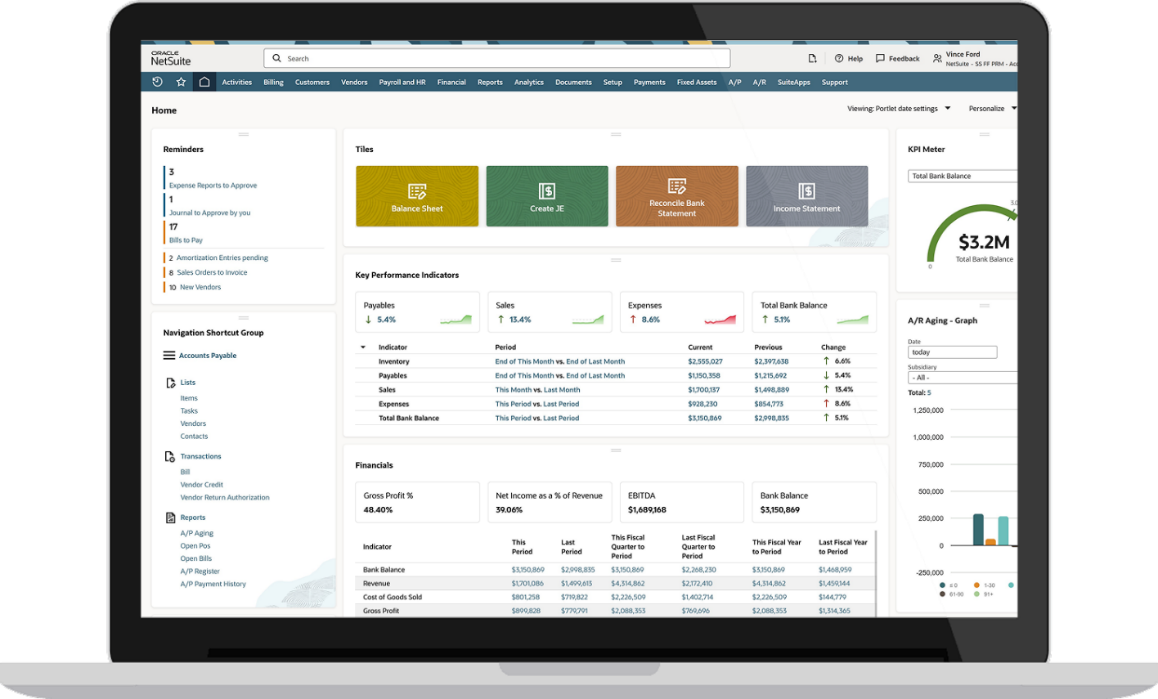
With so many KPIs to track, wealth management firms need a strong, cloud-based system to manage performance in real time. NetSuite ERP Software for Financial Services gives companies a detailed view of the business by bringing financial management, planning, CRM, and operational data into a single system, so they can stay on top of their cash position, operating costs, and margins. Built-in AI detects anomalies and emerging trends behind the KPIs, such as an unexpected increase in operating costs that widens the expense ratio. It then drills into the underlying data to understand why, so managers can respond quickly. A human advisor can further probe that data through Ask Oracle, NetSuite’s conversational AI. And because these AI actions run under the same role-based permissions and approval controls as human users, firms maintain the audit trails required for compliance.
NetSuite ERP Software for Financial Services
The shifts in a wealth management business can be subtle: a few more clients leaving, advisors spending a little more time on administrative tasks, or new assets coming in at slightly lower fees. These signals may not look alarming on their own, but combined, they might reveal a changing business trajectory. Paying attention to every executive, growth, and operational KPI—and acting early when problems surface—can help a wealth management firm stay ahead of challenges and build a business that’s stronger and better positioned for long-term growth.
Wealth Management KPIs FAQs
What are the most important KPIs for a wealth management firm?
A wealth management firm’s most critical key performance indicators (KPIs) include assets under management, net new assets, client retention rate, revenue growth rate, net profit per advisor, and expense ratio. Together, these KPIs show whether a firm is growing, retaining clients and assets, generating profitable revenue, and operating efficiently.
What is the difference between growth and profitability KPIs?
Growth key performance indicators (KPIs) measure whether a wealth management firm is expanding in terms of clients, assets under management, or revenue. Meanwhile, profitability KPIs measure whether that expansion is translating into stronger financial returns. A firm can grow rapidly while profitability declines, so tracking both is essential.
How can a wealth management firm improve client retention?
Firms can improve client retention by providing proactive, personalized service and using CRM data to identify signs of disengagement. Building deeper relationships throughout the household and next generation can also help wealth managers retain clients and assets over the long haul.