
Raising money can feel like the obvious next step for a growing SaaS company, but it isn’t always the best or only choice. Investors might keep their checkbooks closed if the company can’t prove its customers stick around or that it can expand its services and sales processes without breaking. Even if a startup can convince investors to give up their capital, it may leave founders with less control or more debt than they can handle. By understanding how SaaS funding works and the stages and types available to startups, founders can prepare for a raise and effectively manage the capital once it’s in hand.
What Is SaaS Startup Funding?
SaaS startup funding is capital used to build, launch, and develop a software-as-a-service company. It can come from founders’ own cash reserves, customers, angel investors, venture funds, lenders, or government programs; the right combination depends on how much capital the company already has and where it’s going next.
For capital providers, SaaS companies are attractive because their recurring revenue business model suggests confidence in long-term earnings that one-time sales can’t offer. But that confidence holds up only if customers stay. Investors will want to see retention data before they consider revenue to be reliable, especially for a new company with a small customer base.
Key Takeaways
- SaaS startups can access standard venture funding models, as well as nontraditional financing options, due to their predictable recurring revenue and low cost to serve additional customers.
- Funding stages center on what a company needs to prove at each point in its growth.
- From bootstrapping to venture debt, every funding type comes with strings attached, such as equity dilution or repayment obligations.
- Securing the right type of funding at the right time matters.
- Tracking financial metrics and milestones after a funding round closes puts founders in a stronger position for the next funding round.
SaaS Startup Financing Explained
The economics supporting a SaaS company can open financing options that don’t exist for most other businesses. Although standard options, such as angel investment and crowdfunding, are available to subscription businesses, some lenders also offer funding predicated on a SaaS company’s predictable revenue streams, including debt tied to monthly recurring revenue (MRR) or revenue-based financing. Many venture capitalists are drawn to software companies because once the company builds a product, serving another customer costs relatively little. That means the company can rapidly expand without investing heavily in inventory or physical locations.
For founders, though, the right funding approach should reflect the SaaS startup’s specific needs. A startup offering a self-serve product with a short sales cycle might be able to reach customers inexpensively enough to make bootstrapping and self-funding a real option. On the other hand, a SaaS company selling into large accounts will likely need outside capital to build the considerable sales, security, implementation, and support teams that potential enterprise customers need to see before they sign an annual contract.
How SaaS Startup Funding Works
Tech startup funding works best when a founder treats it as a series of ongoing deals, with each step providing new evidence of success for the next round of potential funders. For example, a pre-seed round can show off an idea with real growth potential, while Series A aims to prove that the company can increase that growth. What differs between stages and funding types is who’s willing to bet on it and what they expect in return.
Funding Stages
The line between a substantial seed round and a small Series A varies with business models, investors, sectors, and market cycles. According to the National Venture Capital Association/PitchBook 2026 Yearbook, the distribution of funding stages is changing, with the median seed pre-money valuation rising 78% from 2021 to $16 million, which would have been a “healthy Series A” 10 years ago. Meanwhile, Series A medians reached $49 million in 2025. It’s difficult to make direct comparisons based on stage labels, as the NVCA Yearbook explains, because “when an AI infrastructure company raises $200 million in what it calls a Series A, it is not comparable to a healthcare SaaS company raising $8 million in what it also calls a Series A. They share a label and nothing else.”
That distinction is why the five stages below focus on what a company needs at each stage, not on hard-revenue thresholds:
- Self-funded: Founders rely on savings, consulting income, family, friends, or early customer revenue to develop a prototype and put it in front of real users without giving up full control. These companies tend to grow more slowly, on average, than equity-backed peers, but that gap tends to be widest for small to midsize companies and narrows—or even reverses—for companies with larger annual recurring revenue (ARR), per 2025 SaaS Capital Insights data.
- Pre-seed: Capital usually comes from founders’ networks, angels, or early-stage funds and primarily goes toward validating the customer’s problem and building an early product, often through a paid pilot with a design partner. These investors have little historical data to go on, so they focus on founder/market fit and how quickly the company turns customer feedback into product changes.
- Seed: Companies at this stage typically have paying customers and can prove success through early MRR and subscriber retention data. Seed investors want to see evidence that early revenue wasn’t a fluke and that there’s a repeatable growth path in a market that can comfortably maintain momentum.
- Series A: Investors look for growth in multiple sales channels and net revenue retention as the customer base widens. They also want to see clear objectives, including a plan for how the business will use new funding and how spending will affect the tech startup’s budget.
- Series B, C, etc.: Later rounds typically fund growth, such as market expansions, new product lines, hiring, or a push toward sustained profitability. These investors often expect granular data, such as segment-level gross margins or sales productivity by channel, to see how well the company can support an expanded, more complex business model.
Funding Types
Each source of capital trades a different mix of dilution, repayment obligation, and control for the money it provides, and many offer perks beyond a check. For example, an AI-forward business might seek funding from venture capitalists with a network of investors looking to get in on the AI boom, while an enterprise software company may court investors with cloud expertise to build credibility with more established businesses. The right approach keeps founders comfortable with the trade-offs and investors feeling they’re getting their money’s worth. Types of funding include:
- Bootstrapping: Founders and customer revenue finance the company directly, with no outside investors taking any equity or control. Many SaaS companies can get by with bootstrapping when their digital products are able to reach paying customers without incurring a long sales cycle or heavy up-front inventory spend.
- Angel investors and venture capital: Angels invest their own money, and the best ones supplement their funds with domain expertise and customer networks. Venture funds invest money in exchange for preferred equity and a path to a sizable return, so even solid SaaS businesses may not suit venture capitalists if they can’t grow to meet a fund’s expectations.
- Accelerators and incubators: Business accelerators often jump in early in exchange for equity, run for a fixed period, and frequently end with an investor event that opens networking opportunities for the startup. Conversely, startup incubators tend to be more open-ended and may take no equity at all, as they come instead through partnerships with organizations, such as universities or corporations.
- Government and private grants: Qualifying tech companies can pursue nondilutive R&D funding through programs like America’s Seed Fund, from the Small Business Innovation Research, and Small Business Technology Transfer programs. These programs can provide up to $2 million in seed funding without taking equity. Private and corporate grants exist, too, though terms vary.
- Competitions: Pitch competitions offer equity-free prize money and investor introductions, and even “losers” can walk away with media exposure and an expanded network. However, because they’re often not repeatable, they work best as a supplement to a more sustainable funding plan.
- Business loans: Conventional lenders evaluate credit, collateral, revenue, and cash flow, so loans usually favor established businesses with a track record. For qualifying businesses, loans backed by the Small Business Administration offer support and affordable funding through partner lenders.
- Venture debt: This type of financing is used to supplement a recent equity round to extend runway between funding rounds. Specialized lenders underwrite against certain metrics, such as MRR, instead of accepting collateral. They often charge interest over the loan term and take a small equity stake.
- Crowdfunding and other sources: Regulation Crowdfunding lets companies raise up to $5 million in a rolling 12-month period through a registered platform, although funding comes with disclosure and reporting requirements and a cap on how much nonaccredited investors can contribute. Other nondilutive sources, such as revenue-based financing, are options for companies with steady recurring revenue, but repayments expand with revenue, so they can balloon significantly as growth accelerates.
Do You Need to Fundraise for Your SaaS Startup?
Plenty of reasonable businesses could raise more money but choose not to. Depending on the business’s stage and trajectory, a quick cash injection might not be worth diluting ownership, losing board seats, adding growth pressures, or spending the time and effort needed to raise capital. If the business doesn’t have a validated SaaS product idea and a solid foundation, such as strong customer retention, more funds could end up doubling down on weaknesses.
Signs Startup Funding Is Right for Your SaaS Company
Sometimes the timing of funding matters more than the amount. Here are some signs that it’s time to seek external capital, plus ways to put it to use:
- Demand outpaces capacity: Proven customer demand calls for more engineering, support, infrastructure, and sales capacity than the company has, and funding can help supply it.
- Speed matters: In SaaS, the market rewards being first, and outside capital can help early movers lock in integrations and distribution before competitors capture customers.
- Enterprise deals need more infrastructure: Landing bigger accounts calls for beefed-up sales and security teams, as well as greater implementation and integration expertise than current revenue can support.
- A milestone is in reach: Hitting a goal sooner, such as an enterprise-ready product or a proven acquisition channel, could meaningfully raise the company’s value or open the way to opportunities like bringing in top talent or landing an important client.
- There’s a concrete plan: Founders can explain exactly how they’ll use the capital and the growth it’s likely to produce, so they may be able to secure funds with less dilution or lower interest.
Preparing Your SaaS Startup for Fundraising
Preparation should start well before the first investor meeting. Fundraising rounds are more likely to go well if the company can produce verifiable evidence that tells a consistent story that begins with the pitch deck and extends to the company’s financial records. These five steps can help founders build that narrative.
-
Validating Demand
Customer interviews and feedback can contribute valuable testimonials, but hard commitments do more. Customer data, including pilot-to-sale conversions, implementation fees, prepaid contracts, and ongoing renewals, gives investors a clearer picture of whether there is real demand that translates into sales. This data is even more valuable when broken down by customer cohort or product line to show where the company has the biggest impact. AI tools can help founders sort through this behavioral data to spot which customer segments show the strongest signs of growth.
-
Gathering Key Financial Metrics
Investors look at SaaS metrics for two reasons: to see an overall performance trend and to assess if reality matches the story the founder is selling. Common SaaS metrics to include in a pitch deck are:
- MRR and ARR: MRR is the total value of all active subscriptions in each month; ARR extrapolates that figure over 12 months. One-time and nonrecurring fees, such as implementation charges, generally aren’t included.
- ARR growth: Raw growth can be instructive, but two companies growing at the same rate can look very different if one of them is growing by winning new clients and the other is relying on existing customers who expand their service. KPIs, such as churn and average revenue per user, add context to the source of growth.
- Customer acquisition cost (CAC): CAC includes the salaries, commissions, CRM costs, and marketing budget spent to acquire a new customer, on average, over a given period. Combining CAC with the costs of upselling or growing existing accounts can understate how expensive new-customer growth has become. Segmenting CAC by channel or cohort often reveals more than a single, companywide average.
- Customer lifetime value (CLV): A simple version of CLV—derived by dividing average revenue per account, adjusted for gross margin, by churn rate—collapses for SaaS companies with low churn because the CLV ceiling disappears as churn approaches zero. A cohort-based estimate, built upon actual retention and expansion behavior, is often more accurate than a single ratio.
- Net revenue retention (NRR): NRR measures how much revenue a company retains from existing customers after factoring in expansion, contraction, and churn. NRR can exceed 100% when expansion outweighs the losses from contraction and churn. When NRR is below 100%, existing customers are contracting or churning faster than they’re expanding, which means the company has to lean more on new customer acquisition, a costlier way to grow, just to keep revenue flat.
- Burn rate: Gross burn shows the total monthly cash going out the door; net burn subtracts cash collected from customers during the same period. Burn rate can swing significantly for startups making big investments or paying hefty annual bills, so a trailing average smooths out noise and gives a more reliable read on cash flow.
- Burn multiple: This metric, which divides net cash burned by net new ARR added in the same period, is a common way to track how efficiently a company is spending to generate recurring revenue. For most startups, this number starts higher while the company is still proving its product and drops as the business matures and becomes more efficient.
-
Finding Investors
Founders often build a short list of investors whose stage, sector, expectations, and check size match up with the company to avoid relying on one source that might not pan out. A diverse list is especially important in SaaS and other competitive sectors, where a single investor passing on a deal can mean losing months to a faster-moving competitor with a disruptive new product. Research and peer references can help, too; talking to a fund’s portfolio founders—including any whose companies struggled—can reveal more about an investor’s behavior and partnership qualifications than anything shared during a pitch meeting. Using AI-powered research tools to track down an investor’s portfolio, typical check size, and recent activity will produce results faster than manually combing through public filings.
-
Creating Your Pitch
Drafting the first pitch deck is rarely the final arbiter of funding approval. The strongest decks ground the funding request in evidence that the product solves a real customer problem, then go on to show a convincing path from the current customer base to a larger one. Many investors now run inbound decks and data rooms through an AI screen before a partner reads them, so clean, consistently labeled metrics can matter as much as the narrative itself. To get ahead of uncomfortable questions from investors after the pitch, include details about why customers may cancel their subscriptions, where the company has fallen short of expectations, what steps the company is taking to keep customers subscribed, and contingency plans should the next funding round not be available on schedule.
-
Planning for Due Diligence
Due diligence checks the startup’s story against the paperwork. Be sure to include corporate structure, a capitalization table to show current equity ownership, intellectual property, and commercial contracts. AI agents can quickly comb through paper trails and produce a list of any missing documents or inconsistent records with suggestions on how to clear up discrepancies before investors start searching. For example, a cap table that accounts for every simple agreement for future equity, or SAFE, instrument, option grant, and prior round avoids discoveries and delays during due diligence. For AI-forward SaaS companies specifically, investors frequently ask about data rights, model dependencies, internal controls, and how much of the product’s cost structure depends on APIs with third-party AI providers, since those answers affect long-term cost controls and reliability.
Managing Funds and Tracking Progress
Once funds are in hand, the priority shifts to growth and using that cash to survive until the next funding round and generate more evidence that the business is a worthy investment. Proper fund management often concentrates on five areas—and continually tracking them helps startups measure stability and trends:
- Cash runway: Runway is unrestricted cash divided by average monthly net burn, but a single financial period can be misleading if there are outlier events, such as a hiring rush or a seasonal collection cycle. Rolling cash flow forecasts provide a more authentic read on how long the company can survive at current subscription levels and spend rates.
- Burn rate: Tracking burn monthly catches spending problems while there’s still time to reverse course. A rising burn rate that’s outpacing ARR growth is one of the most common early signs that a startup is overextending its resources. Many finance teams now use AI-assisted tools to monitor spend and to alert teams in real time about unusual expenses or burn-rate spikes.
- Budget and milestones: A milestone-based budget releases spending as results come in, as opposed to approving a full annual budget up front. For instance, basing paid acquisition spend on early conversion data can help teams target where they’re most likely to earn returns.
- Revenue: ARR is a management metric, not a cash balance. It doesn’t move alongside recognized revenue or cash collected, so renewal calendars and rolling cash flow forecasts assist financial planning. For example, a 12-month contract signed in December might count toward ARR right away, get recognized in equal monthly proportions under ASC 606 (the Financial Accounting Standards Board’s revenue-recognition standard), but not generate cash until the customer pays the invoice, sometimes after payroll is due.
- Planning the next financing round: It’s generally easier to raise capital when investors can see healthy financials and there’s less pressure to close the deal immediately. Founders who keep their data up to date with integrated software or use AI-powered scenario modeling that projects how a new hire or a slow sales quarter would shift runway can help founders time their next raise without reacting to a cash crunch.
Monitor Your SaaS Startup’s Financial Progress With NetSuite
Manually reconciling contracts and recognized revenue works fine at first, but it breaks down as startups add new entities and currencies. NetSuite Financial Management consolidates accounting, subscription billing, planning, and revenue management in a single platform, so a growing SaaS company can trace a figure from a signed contract through the board report without manually rebuilding a spreadsheet. Built-in AI capabilities, including a subscription metrics dashboard that tracks CAC payback period and NRR, combined with scenario-modeling tools that project how changes would shift cash runway, give finance teams a faster way to stress-test the story before investors do. For founders preparing to fundraise, unified data throughout every pitch deck and financial statement can be the difference between a signed check and “we’ll pass.”
NetSuite ERP’s Financial Management Dashboard
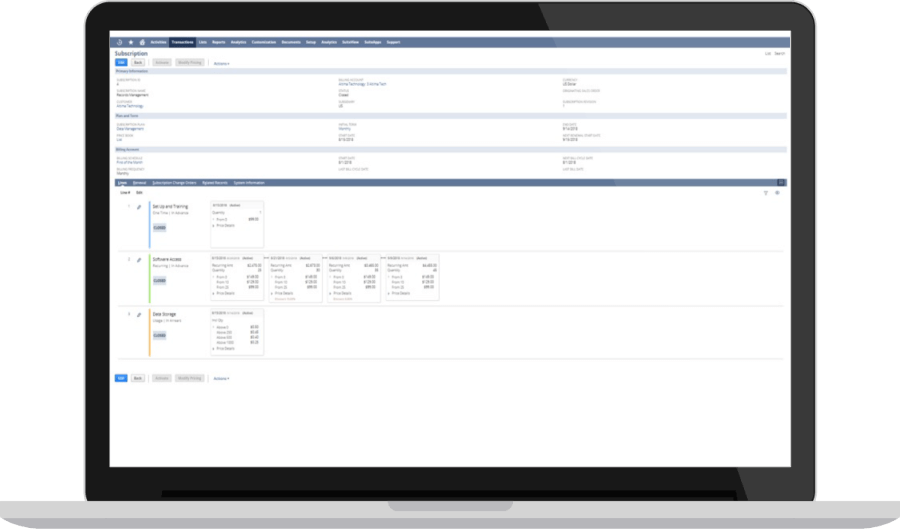
The founders who raise capital well aren’t always the ones with the most polished deck or biggest revenue signals. They’re often the ones with a precise plan for each dollar, a plan backed by comprehensive metrics that hold up under scrutiny. Such precision extends to determining which funding types a startup pursues and when it draws on investments to maximize its available capital.
For startups that aren't quite ready for a full financial management suite, NetSuite's QuickStart delivers an AI-powered accounting platform packed with early-stage essentials. QuickStart brings automation to balance sheets, invoices, subscriptions, and more, giving startups a real-time look at financial progress through a conversational interface connected to the AI you already use.
SaaS Startup Funding FAQs
How much money do I need to raise for my SaaS startup?
SaaS startup funding is usually paired with specific, value-increasing milestones. Many funding strategies include buffers for delays and leave enough runway for the company to outlast the next fundraising round without cash running dry. Amounts tend to revolve around a monthly cash flow model that’s aligned with realistic performance benchmarks, since burn, sales cycle, financial obligations, and margin structure directly determine how much funding the company will need.
What are the main sources of funding for early-stage SaaS startups?
Early-stage founders typically draw on personal savings, customer revenue, friends and family, angel investors, accelerators, and grants or revenue-based financing. Then, as the business matures, venture capital enters the picture in later funding rounds. The right source depends on the business. Open-ended and uncertain products usually fit risk-tolerant equity better than fixed debt obligations, while companies with predictable working capital may be better suited for debt- or revenue-based financing.
How do venture capital firms evaluate SaaS companies for funding?
Venture capital firms weigh the founding team, market size, product differentiation, and traction collectively when assessing a pitch. The emphasis shifts by stage—early investors often lean more on team and problem, while later-stage investors usually prioritize retention and forecast accuracy. They also check whether a company complements their fund, since even a great business can be a poor fit if the likely outcome doesn’t match the fund’s goals.