
Every quarter brings another headline about record-breaking venture funding. But for founders trying to raise a modest seed round, “record-breaking” isn’t exactly the phrase they’d use. That’s because most of that funding is chasing a handful of massive AI rounds, leaving everyone else pitching into an investment market that’s far more selective than the numbers suggest. A pitch deck is often the first real test of whether an investor continues past the cover, and it has to work fast. This article walks through the 13 slides a strong investor pitch deck needs to include, how the story should shift by fundraising stage, and the mistakes that get founders passed over.
What Is an Investor Pitch Deck?
An investor pitch deck is a short, visual presentation entrepreneurs use to introduce a business to potential investors and make the case for funding. It usually walks through the problem the company solves, its product, the market, traction, and how much capital it needs, condensed into a format an investor can review in a single sitting.
Founders often build more than one version of their pitch decks—a shorter one to send ahead of a first meeting and a longer one to present in person or leave behind afterward. The shorter version has to work without a founder in the room to explain it. The longer one exists for when they are.
Key Takeaways
- A pitch deck usually comprises 13 core slides, but only a handful draw the most investor engagement.
- Investors are pricing early-stage rounds higher than they did a few years ago, so every stage now needs stronger proof to match.
- Team and market should carry the pitch early on, with revenue and retention taking over as the company matures.
- Founders who name their own weak points control the conversation more than those who wait for an investor to point them out.
Why Does Your Investor Pitch Deck Matter?
A pitch deck is generally the first piece of marketing collateral you’ll share with a VC firm or angel investor. For many investors, whether it lands determines the likelihood of a second conversation. North American startups raised a record $392 billion in the first half of 2026, but that total was driven by a handful of massive rounds for a few AI companies. Deal counts stayed well below prior highs, even as the dollar totals climbed.
The squeeze is more evident at the deal-size level. Seed and pre-seed deals between $200,000 and $5 million made up 93% of US seed-stage deal count in 2018. By 2025, that share had fallen to 75%, as capital concentrated in outlier rounds of $10 million or more.
A pitch deck is built, first of all, to win the actual pitch meeting. From there, it takes on a second job: building the case internally after the meeting ends. Investment committees rarely approve deals because one partner liked a meeting; they approve them because a partner can point to specific slides and numbers that hold up under questions from colleagues who never saw the original presentation.
Creating Your Investor Pitch Deck: 13 Slides to Include
A fundraising deck consists of a series of slides designed to persuade investors to back the company. Following are 13 slides most investors expect to see, and what each one needs to accomplish.
-
Cover and Company Overview
The cover slide holds about 45% more investor attention than the media page because it’s where investors decide whether to continue reading, according to Papermark’s analysis of more than 24,500 shared pitch decks. As such, it should include one sentence that states what the company does and for whom—in clear language that a potential investor would be able to repeat from memory a week later.
-
Problem Statement
A strong problem slide shows that the market’s pain is real. The task that eats up a specific amount of a target customer’s day says more than a broad statement about an inefficient market. If a startup sells into a market investors might not recognize by name, the slide should state plainly which market and which buyers face this problem.
-
Solution Introduction
This slide connects back to the problem slide to explain what the product does and how it solves the pain points described. (Deep technical detail should be included later in the product slide or in the appendix.) The slide’s goal is to connect the problem to the fix in a way a nontechnical partner could follow. At this point, a short example of the product in action will likely land better than a list of features.
-
Why Now (And Why You?)
Investors want to know that the startup’s timing makes sense. A recent shift in, say, a technology or regulation that made the startup possible gives the timing argument teeth. The slide also needs a believable answer to why the startup’s team is best positioned to act on the new opportunity, whether through domain experience, a technical edge, or early market relationships.
-
Market Opportunity and TAM
Investors are likely to discount a large, top-down market number on its own and look instead for a realistic customer count multiplied by a realistic price. The initial wedge—the specific segment of first customers a company can credibly win—outweighs the size of the category’s total addressable market (TAM). A brief explanation of how that wedge can expand into a larger market gives investors a believable growth story they can weigh against the slide’s assumptions.
-
Product Overview
This slide shows the new offering in action, preferably through screenshots or a short demo video. If AI is part of the product, include specifics about what it does and why it’s hard to copy; today’s investors can spot the difference between legitimate AI and AI-washing quicker than ever. A recent analysis of self-described AI startups by Silicon Valley Bank found that roughly two in five showed little evidence that AI was central to their technology. On the other hand, true AI differentiation continues to attract strong investor attention, with 60% of Q1 2026 venture dollars going to AI companies, per Carta.
-
Traction
Traction slides hold particular weight, but investors read them rather skeptically. An analysis of the fastest-growing AI companies by Bessemer Venture Partners found they reached about $40 million in revenue in their first year but ran on gross margins nearer 25%—and frequently negative. Steadier companies hit about $3 million in year one, with margins closer to 60%. Investors are more likely to view revenue combined with customer retention and margin—and labeled as signed and billed or annualized from a recent spike—as more credible than the figures on a growth chart alone.
-
Business Model
This slide explains how the company makes money: the pricing structure, who pays, and how revenue repeats or expands over time. Subscription, usage-based, transaction, and licensing models all come with different unit economics. Investors can benchmark the business more precisely once they know which model is in use, because revenue described only in the abstract is hard to compare among companies. If pricing has changed since launch, a short note explaining why sends signals that the team is pricing based on customer feedback.
-
Marketing and Sales Strategy
The go-to-market slide answers a practical question: How will the company find and close its next 100 customers? The specific channels in use—be they outbound sales, product-led growth, partnerships, or paid acquisition—and the actual cost to acquire a customer through each one give investors a way to judge whether growth is repeatable. Investors often interpret too many untested channels as too many points where the growth story could fall apart, whereas one channel with real numbers behind it reads as evidence.
-
Competitive Analysis and Market Differentiation
To investors, a deck that says a company has no competition can smack of a lack of research. Most lucrative markets attract a flurry of founders hoping to capitalize on the same opportunity. Competitive intensity in AI-adjacent categories has surged, attracting two to three times the number of rivals as in prior years. A competitive slide acknowledges alternatives, including adjacent tools and the manual workarounds customers currently use, and provides specific, defensible reasons why the startup is a better solution.
-
Financial Performance and Milestones
This slide presents revenue history, burn rate, and a forward projection grounded in the assumptions behind it. Realistic benchmarks help set expectations. Carta’s Q2 2026 data puts the median seed round at $4.5 million on a $23.9 million post-money valuation, with median dilution around 19.4%. That gives founders a sense of what a well-supported seed-stage financial story looks like next to investor expectations. A break-even analysis and the startup’s most recent financial statements give investors documentation to check against the slide’s numbers.
-
Executive Team
This slide explains why the startup team is the right one to execute the plan described. Relevant experience, such as domain expertise or a prior exit, carries more weight than an impressive resume. A team slide that names any open roles and the plan to fill them, such as a search underway for a technical cofounder, tends to read as candid rather than cagey.
-
Your Ask
State the funding amount, along with what it will fund and the specific milestones each round needs to reach before the next one. Investors tend to respond better to a plan that incorporates runway with solid proof points. Leaving the exact valuation open pending a live conversation gives a founder more room to negotiate.
The Investor Appendix: What Belongs in Supporting Material?
The core pitch deck should be lean enough to read in one sitting; provide supporting details afterward so as not to interrupt the narrative. A data room or appendix is the place for a full financial model, a detailed cap table, customer references and case studies, technical architecture documentation, and any letters of intent or signed contracts that back up the traction slide.
Keep this material behind a gated link with view-tracking that shows which investors are looking at diligence-level detail. Sensitive information, such as unfiled IP or named customer data, should also go behind this gate.
Building a Compelling Narrative Based on Fundraising Stage
The story a deck tells has to change as a company matures. For example, using seed-stage evidence for a Series A pitch, or the reverse, reads immediately as a mismatch to investors. Here’s what pitch decks for each stage should communicate.
Pre-Seed
At this stage, most investors aren’t evaluating the business yet; they’re evaluating a team and an idea. The money itself is used to test whether the idea holds up before there’s any product to show. Typical pre-seed rounds still run small, generally up to about $200,000, so the deck can be short. A few slides on the team and the problem carry more weight than a detailed financial model.
Seed
By the time a startup reaches this stage, it probably has a live product and early customer feedback. The deck should lean into early proof of success. Seed rounds have grown considerably. The median US seed round hit around $3 million last year, three times what it was in 2018, with top-quartile rounds closing above $5.6 million. That means the bar for a seed deck has risen, too. Showing a path to the metrics eventually required by a Series A matters as much as current traction.
Series A+
A Series A deck should prove the business works at a larger scale. Fewer companies are making that jump than they used to. Through 2020, slightly more than half of seed-funded companies with at least $1 million raised eventually moved to a later round; that graduation rate fell to roughly 16% in 2024. Median Series A rounds now land around $20 million in 2026, so the deck needs to show retention data, expansion revenue, and a growth story investors can believe in.
Best Practices for Designing a Winning Pitch Deck
Strong content still needs the right presentation to land. A handful of practices gives decks a higher chance of getting read:
- Put yourself in the shoes of the investor: Assume limited time and a full inbox. Papermark’s analysis of investor deck views found reading time is sharply split. About 16% of views end within 10 seconds, while roughly one-third run longer than 3 minutes, with very little difference in between. In other words, a deck either earns a real read in the first few slides or it gets set aside, so write for the skim first and the deep read second.
- Keep slides simple: Give each slide one idea and put that idea directly in the headline. A deck crammed with every possible detail makes it difficult for investors to read through. Extra detail belongs in the appendix or in the memo.
- Nail the hook: The weakest hooks describe a category, such as “a fintech platform for SMBs.” The strongest ones name a specific number or outcome that no competitor in the category can claim: “We get small businesses paid in 4 days instead of 45.” That single number replaces what previously took a whole slide of context to explain.
- Be intentional with your metrics: Favor KPIs that express a rate or percentage against a stated base—such as retention as a share of last quarter’s customers—over a total that sounds big on its own. Keep labels precise, too. A projection isn’t the same as signed revenue, for example, and an investor can catch that mix-up quickly during due diligence.
- Be honest about your competition: An investor will often name competitors left out of a deck to test whether a founder reacts defensively or addresses the point directly. A candid answer in that moment about a rival’s genuine strengths builds trust.
- Ask for feedback: A deck can’t carry all the context that’s sitting in a founder’s head. Advisors or other founders who read the deck cold will catch the confusing spots a founder can’t see on their own. And if a real investor passes, asking a direct question about what didn’t land is worth any discomfort.
- Review and update your pitch as your business grows: Pre-seed pitch decks aren’t likely to fit a company six months later, once there’s real traction to show and old assumptions have either held up or been proved wrong. Revise the deck after every investor conversation to align it with where the business stands over time.
- Make your ask transparent: Skip a valuation number as the headline. Instead, state what the round will fund and the milestones it should reach. Financial details are worth the space they take. The financials slide holds above-average investor attention, yet 6 decks in 10 leave it out entirely, according to Papermark.
Reviewing Your Pitch Deck: Avoid These Common Mistakes
A well-researched deck can still lose an investor’s confidence through a handful of avoidable missteps. Watch for the following mistakes before sending out a deck:
- Don’t try to explain everything: The more a deck tries to answer, the more likely investors will find something they disagree with. Save the deeper detail for a memo or a conversation that follows.
- Don’t use vanity metrics: A number needs to trace back to something concrete, such as an actual signed contract an investor can check.
- Don’t make inflated claims: Investors read a projection built on flawless execution and no competition as a sign the founder hasn’t stress-tested their own plan. They’ll test that assumption with a direct follow-up question the moment a number looks too clean.
- Don’t use inaccessible jargon: Jargon signals expertise to the one reader who already knows the field and confusion to almost everyone else in the room. The product description needs to work for anyone who picks up the deck, technical background or not.
- Don’t deny weaknesses: Every business has open questions, such as reasons for a long sales cycle, a concentrated customer base, an unresolved technical risk, or a founder not yet working full-time on the business. Due diligence will turn these up, so a founder who names a weakness directly, along with a plan to address it, builds more trust than one who pretends it doesn’t exist.
What Investors Should Ultimately Gain from Your Pitch Deck
A pitch deck’s job isn’t only to elicit a yes. After all, a well-informed rejection delivered inside 10 minutes frees up a founder’s time for the next investor. Either way, an investor should leave with a clear sense of what would have to be true for the offering to become a great investment and enough faith in that understanding that no further meeting is needed to decide.
NetSuite Gives You Better Visibility into Your Financials
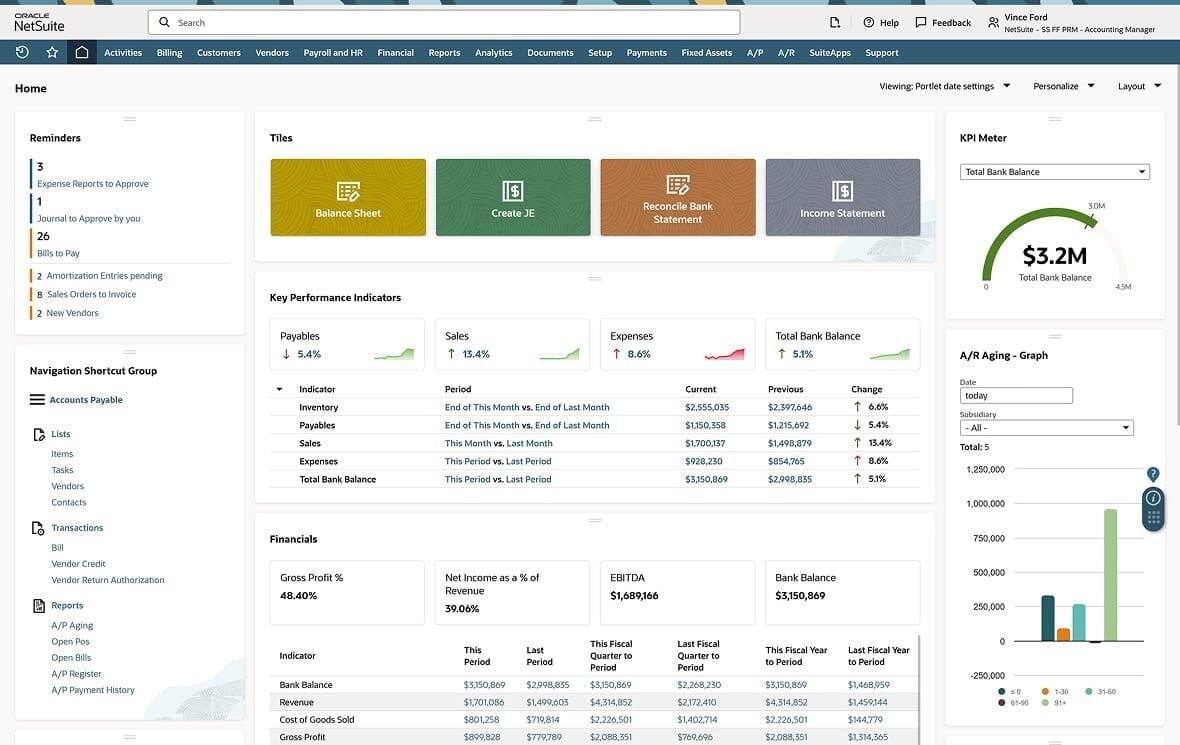
A credible financial story for investors is difficult to build when the numbers live in spreadsheets a controller updates by hand before every board meeting or fundraising conversation. NetSuite Financial Management keeps revenue, cash, and forecasts current as transactions post, so the figures behind a pitch deck match what’s available the moment an investor asks a follow-up question. NetSuite’s Narrative Insights feature generates a plain-language explanation of what’s driving a swing in revenue or margin, and Predictive Planning shows the assumptions behind a forecast; both elements help founders defend the numbers on the financial performance slide by providing detailed support.
Financial Visibility That Holds Up Under Investor Questions
A pitch deck can’t manufacture strength a business doesn’t have, but it can hide strengths if the best evidence—financial or otherwise—is buried on a slide at the back of the deck, past where most investors stop reading. Even if they make their way through the entire deck, an impressive first read isn’t a pitch deck’s whole job. The deck also has to survive when someone goes back through it again, line by line, with an eye for details that may not hold up. The version that endures is rarely the flashiest. It’s the one with nothing left to explain away.
For startups that aren't quite ready for a full financial management suite, NetSuite's QuickStart delivers an AI-powered accounting platform ready to support investor pitch decks. QuickStart brings automation to balance sheets, invoices, subscriptions, and more through a conversational interface to give startups a real-time look at the numbers whenever investors need more information.
Investor Pitch Deck FAQs
How do I pitch my startup to investors?
Lead with the strongest available proof point. Send it out ahead of the meeting so investors can review it before you talk, then use the live conversation to go deeper into the questions it raises. A written memo that expands on the numbers and the plan often helps, giving investors something more substantial to carry into their own partner meeting.
What do investors look for in a pitch deck?
Investors look for evidence of a real problem, a working product that addresses it, and traction or milestones that show momentum. Beyond the numbers, they’re reading for how well a founder understands the business, including whether the metrics on the traction slide are labeled truthfully.
How long should a pitch deck be?
Most decks that hold investor attention land between 9 and 16 slides, with 12 slides as a consistent sweet spot, according to one large analysis of shared decks. Anything essential that doesn’t fit belongs in an appendix.
What is the 10/20/30 rule for pitch decks?
The 10/20/30 rule, created by investor and former Apple chief evangelist Guy Kawasaki, suggests 10 slides, a 20-minute presentation, and no font smaller than 30 points. The slide-count guidance holds up reasonably well against current data on deck length, but the rule was built for a live, in-person pitch. Today, most decks are read on-screen before a meeting, so completion rate and a strong first slide do more work than a fixed-length presentation time.
What should you avoid in an investor pitch deck?
Avoid vague claims that are hard to verify, inflated projections that don’t connect to a believable plan, and jargon that forces an investor to guess at what a slide means. Founders should also resist the instinct to hide known weaknesses; investors usually find them anyway during due diligence.
How can I improve my pitch deck to attract investors?
Ask investors and other founders for direct feedback on where a deck loses them, then revise the deck based on patterns that arise across several reviewers. AI-powered design tools can also help produce a clean, professional layout without hiring a designer, though the content and numbers still need to hold up on their own. Revisiting the deck every time the business hits a new milestone keeps it fresh between rounds.