
A small business owner calls a bank with a simple question: “Why hasn’t my loan been approved yet?” For the bank employee attempting to answer that question, the correct response may not be as straightforward as it seems. Finding the information might entail checking multiple systems, chasing down updates from different teams, and piecing together where the application stands amid a flurry of necessary approvals. Ultimately, this results in more time wasted—and both the employee and customer often end up frustrated.
Improving operational efficiency in the banking industry focuses on creating systems that move faster, serve customers better, and adapt more easily to today’s super-competitive financial services environment. And in a sector where profit margins are growing tighter all the time, operational efficiency also helps lower expenses. This article explains why operational efficiency is important, outlines the different ways banks can measure their performance, and provides six strategies for creating smoother processes and better customer experiences.
What Is Operational Efficiency in the Banking Sector?
Operational efficiency in the banking sector refers to a bank’s ability to deliver financial products and services fast, while minimizing operating costs and maximizing the value generated from its resources. This metric is commonly measured by the bank efficiency ratio, which compares noninterest operating expenses to net revenue, with lower ratios indicating greater efficiency.
Key Takeaways
- Rising costs and moderating revenue growth are making operational efficiency a strategic priority for banks, as they concentrate on protecting profitability.
- Embedding compliance into operational workflows through automated controls lets banks eliminate manual effort, maintain stronger oversight, and simplify regulatory reviews.
- Banks are changing how they use branches and staff by shifting routine tasks to digital channels and directing employees toward higher-value customer conversations.
- Banks typically track the efficiency ratio, cost-to-income ratio, operating expenses, return on assets, and straight-through processing rates to identify inefficiencies and improve operations.
- From reviewing borrower documents to detecting suspicious transactions, AI is helping banks cut back on manual work and speed up decisions.
Bank Operational Efficiency Explained
The US banking industry remains profitable in 2026, yet improving operational efficiency has become a top strategic priority as banks face mounting pressure from persistent cost inflation, evolving regulatory requirements, and growing customer expectations for seamless digital experiences. In fact, as financial services organizations are being asked to do more with less, bankers identified operational efficiency as one of their top three business challenges for the first time in a 2025 survey by ProSight, a financial services industry association.
Although the FDIC doesn’t publish an industrywide efficiency ratio benchmark, banking analysts generally consider a ratio in the 50% to 60% range as a sign of relatively strong operating performance. A ratio of 60% means a bank spends roughly 60 cents in noninterest expenses to generate every dollar of revenue. Larger institutions often operate below this range, while smaller community banks may report higher ratios because they have fewer opportunities to spread fixed costs across a broad revenue base. Many banks are shifting their focus from short-term cost reductions to long-term operational improvements that improve productivity and set up the business for growth.
Bank Operational Efficiency Initiatives in Action
Financial institutions are pursuing five main initiatives to operate more smoothly, with the goal of strengthening long-term profitability and remaining competitive:
- Branch analytics and optimization: To understand how customers interact with physical branches, banks can use predictive analytics to identify patterns in transaction volumes, staffing needs, and service demand, all sorted by both location and time of day. These insights allow banks to improve both the allocation of resources and the customer experience, transforming branches from transaction centers into higher-value advisory hubs.
- Back-office digital transformation: For decades, administrative functions, including loan processing, document management, compliance reporting, and account servicing, have relied on fragmented systems and manual workflows. A back-office digital transformation that incorporates ERP, robotic process automation, AI, and intelligent document processing can connect siloed systems and automate routine processes, resulting in a system that speeds workflows and cuts costs.
- Enhanced fraud detection: Financial institutions are increasingly relying on AI and machine learning to analyze millions of transactions in real time to identify suspicious behavior that may indicate fraud. These sophisticated detection models assuage the operational burden on fraud teams by curbing financial losses and minimizing false positives.
- Customer onboarding automation: Opening a new account or originating a loan often requires identity verification, data entry, regulatory screening, and multiple approvals. Automated onboarding platforms move this process along through digital identity verification, workflow orchestration, and electronic document management so that application approvals get processed quickly and accurately.
- Self-service portals and digital banking: Digital channels allow customers to complete many routine banking tasks independently, such as transferring funds, depositing checks, updating account information, and applying for credit cards. Expanding self-service capabilities lets banks serve more customers efficiently and scale operations without increasing staff.
Why Is Operational Efficiency Critical for the Banking Sector?
Operational efficiency has become a strategic necessity for banks because it directly affects profitability at a time when revenue growth is moderating and operating costs have increased. In fact, the FDIC announced in February 2026 that although industry earnings improved overall in the fourth quarter of 2025, higher noninterest expenses continued to weigh on performance.
Finding ways to boost operational efficiency is one of the few levers banks can control to protect profitability. At the same time, customers expect faster, more personalized, and frictionless banking experiences, requiring institutions to modernize operations without significantly increasing costs. Competition for deposits and ongoing regulatory demands further ratchet up the pressure to do more with existing resources, making operational efficiency essential for slashing expenses and sustaining long-term competitiveness.
What Are the Core Components of Banking Operational Efficiency?
The following components form the foundation of an operating model that allows banks to respond more quickly to an evolving financial landscape:
- Automation and AI: More banks are using AI and business process automation to assist with high-volume processes, such as loan origination, account opening, payment processing, and anti-money laundering monitoring. Automating these workflows cuts back on processing times, raises data accuracy, and gives employees more time to work on complex underwriting, exception handling, and building stronger customer relationships.
- Process optimization and standardization: Too many banks still depend on fragmented workflows that vary by branch or business line. A commercial loan may pass through multiple departments, require duplicate data entry in legacy systems, and stall while waiting for manual approvals. Standardizing core processes, such as account opening and dispute resolution, eliminates unnecessary handoffs between teams and shortens cycle times. It also creates the consistency a bank needs to scale automation and AI throughout the business, instead of having to add it one department at a time.
- Analytics and measurement: Most banks struggle with operational bottlenecks, but it may not be obvious where work is slowing down. Is mortgage underwriting delayed due to document collection, or are payment exceptions piling up in a particular operations center? It’s important to measure operational performance at the process level by tracking a variety of metrics, including loan approval turnaround times, onboarding completions, and straight-through processing rates. Gaining a granular level of visibility through detailed data analytics helps banks identify exactly where work is stalling, so they can effect changes.
- Internal compliance controls: A faster loan approval process isn’t much of an improvement if it increases regulatory risk. The key is building compliance directly into operational workflows, using automated controls to verify customer identities, spot unusual transactions, document approvals, and maintain audit trails without adding extra manual steps. When compliance is embedded into the process, banks spend less time responding to audit findings and preparing for regulatory reviews.
- Vision and roadmap execution: Banks may have all kinds of ideas on how to improve operations, but at the end of the day, execution often falls short. In some cases, it’s because banks have too many balls in the air—which means little gets done. A strong efficiency strategy requires leaders to decide which processes deserve investment, which activities should be eliminated, and where standardization matters more than customization. Treating efficiency as a companywide goal keeps everyone on the same page and moving toward the same targets.
- Employee adoption: Tellers, loan officers, underwriters, operations teams, and compliance staff all interact with new systems differently, and each group needs to understand how the tools improve their daily work. Banks often see the greatest gains when they involve employees early and provide practical training. They also need to welcome feedback to understand where employees are having issues and to determine if changes to processes may be in order.
- Digital transformation and modernization: Modernizing a bank’s digital capabilities entails connecting fragmented platforms, improving data accessibility, simplifying workflows, and limiting the amount of manual work tied to legacy infrastructure. As margin pressures persist, banks are recognizing that digital transformation is critical for improving efficiency and long-term profitability. In fact, the banking industry’s top investment priority in 2025 was technology integration and platforms, according to ProSight.
6 Strategies for Improving Bank Operational Efficiency
As banks take a critical look at how work flows through their organizations, where resources are allocated, and which processes no longer support their business goals, the following six strategies can help them construct a more reliable operating model.
-
Evaluate Branch and Staffing Needs
The role of the physical branch has changed significantly in the past decade. About 76% of consumers now manage their bank accounts primarily through mobile apps or online banking, while just 9% rely on branches as their primary banking channel, according to the American Bankers Association. Yet, branches still play an important role for mortgage applications and financial planning. As a result, many banks are redesigning branch networks, consolidating overlapping locations, adjusting staffing levels in line with customer traffic, and shifting tellers into more advisory roles. At the same time, centralized operations centers are taking over routine administrative work, allowing frontline staff to spend more time serving customers.
-
Standardize and Automate Core Processes
Banks should regularly evaluate how work gets done, identifying any similar processes that vary among business lines and thus generate unnecessary complexity and increased operational costs. Banks can improve efficiency by bringing teams together to follow consistent workflows and eliminating unnecessary steps—all before adding new technology. With streamlined processes in place, automation can deliver greater impact by accelerating certain tasks, such as document verification, customer onboarding, payment reconciliation, and regulatory reporting.
-
Align Operations With Business Priorities
Operational efficiency starts by asking whether current processes, staffing models, and technology investments support a bank’s broader business objectives. The right priorities may look different, depending on the bank’s strategy. A regional bank growing its small-business portfolio might focus on speeding up the loan process to shorten the path from application to approval. Meanwhile, a bank intent on wealth management might prioritize giving advisors a complete view of each client’s financial picture by integrating deposits, lending, investments, and planning data so advisors can offer more personalized guidance.
-
Transform Core Digital Systems and Infrastructure
When banks depend on disconnected technology platforms that have accumulated years of patches and extensions, even the simplest tasks can become cumbersome. An employee opening a new account, servicing a loan, or investigating a transaction may need to pull information from multiple systems and reconcile data. Digital transformation simplifies this environment by integrating platforms and retiring redundant applications—and it’s that consolidated data that makes AI-driven operations possible. Agentic AI needs visibility into accounts, transactions, and workflows to coordinate multistep processes without human intervention. In compliance, for example, AI agents can scan transaction volumes, identify patterns that look unusual, and route only those cases to investigators. The result is faster investigations and fewer transactions falling through the cracks, while the final call on any suspicious transaction still rests with experienced banking professionals.
-
Analyze and Optimize the Customer Channel Mix
Banking customers want to be able to choose how they get answers—through mobile apps and websites, by calling into contact centers, or by walking into branches. And they certainly don’t want to have to repeat information or restart transactions with multiple employees. Yet, many banks still operate these channels independently, which can create delays and frustration for customers and employees alike. A customer checking a balance or transferring funds doesn’t need the same level of support as a 65-year-old executive planning for retirement. Financial firms should continually assess which activities are best handled through digital channels and which benefit from a more personal experience, and steer employees toward higher-level conversations when appropriate.
-
Strengthen Data and Performance Analytics
Banks are swimming in data, but the challenge lies in figuring out which operational metrics actually matter. Organization-wide measures—efficiency ratio, cost per account, operating expenses—are important, yet they may not reveal kinks in specific processes, such as mortgage applications being delayed because employees are bogged down with incomplete documentation. It’s important to use granular operational data—for example, tracking the time required to approve different types of loans, the percentage of applications needing manual work, or the steps necessary to complete a customer request. Plus, with a strong data foundation, AI systems can identify patterns and recommend next steps to improve operations.
Measuring Banking Operational Efficiency
Financial institutions tend to look at a combination of profitability, cost, productivity, and process-level KPIs to get a better handle on their overall performance. Specifically, banks often measure these six factors:
- Cost-to-income ratio: This remains one of the most closely watched measures of a bank’s operating discipline because it shows how effectively a bank converts revenue into profit after expenses. A rising ratio can signal that costs are growing faster than revenue, possibly because of increased spending, higher compliance costs, or inefficient processes. A bank might evaluate this metric for multiple business lines to determine where investments are generating returns or whether certain expenses should be scaled back.
- Efficiency ratio: This long-standing benchmark measures how much a bank spends to earn each dollar of revenue, calculated as operating expenses divided by revenue. A lower ratio is better; for example, a 50% efficiency ratio means the bank spends 50 cents to generate a dollar of income. A ratio that’s creeping upward can signal underlying problems, such as redundant technology platforms or workflows bogged down by too many steps. By pairing the metric with process-level data, bank leaders can pinpoint where the inefficiency is situated and redesign those operations to strengthen productivity.
- Operating expense ratio: This ratio helps banks understand how much of their resources are being consumed by running the institution. Expenses include salaries for personnel, technology upgrades, maintaining facilities, and administrative costs. As banks balance investments in AI and digital platforms against the pressure to control expenses, they’re tasked with making sure their spending is aligned with their strategic priorities. A bank might evaluate whether maintaining overlapping customer-service platforms is too expensive and instead consider consolidating those systems.
- Return on assets (ROA): This broad profitability measure provides important insight into whether a bank is using its assets effectively to generate earnings. Executives often evaluate ROA along with operational metrics to determine whether efficiency initiatives are creating measurable business value, rather than merely reducing costs. A bank that shortens commercial loan approval times may book more loans as it cuts administrative costs, lifting ROA on both fronts.
- Straight-through processing (STP) rates: STP rates measure how much work can move through the organization without involving manual processing. Higher STP rates typically indicate that processes are well-designed and data flows smoothly among systems, which translates to employees spending less time on routine tasks. Banks may track STP performance in several areas, including payments, account openings, and securities processing, to evaluate how many transactions are completed automatically versus those requiring employee review.
- Net interest margin (NIM): NIM is critical because it reflects how effectively a bank manages the spread between what it earns on loans and investments and what it’s paying for funding. Changes in interest rates, deposit competition, and lending demand can all affect a bank’s NIM. Although banks can’t control market factors, such as interest rates, they can control how efficiently they operate. So institutions facing pressure on lending or deposit spreads often look to protect profitability by refining operations and trimming processing costs to offset the squeeze.
Tips for Benchmarking Operational Efficiency in the Banking Sector
To get the clearest picture of a bank’s operational efficiency, benchmark against institutions with similar characteristics. After all, a community bank serving local businesses likely has different operating realities from a national bank with a much larger footprint. Identify a peer group with a similar asset size, customer base, product mix, and business model, then track performance trends over time. Just as important, benchmark internally. If one branch consistently opens accounts faster or a certain operations group resolves payment exceptions with fewer errors, study what those teams are doing and apply those practices more broadly.
Additionally, pair high-level measures, such as the efficiency ratio, ROA, and cost-to-income ratio, with process-level data that tracks workflows. This might include data on loan decision times, the number of abandoned digital applications, fraud investigation backlogs, and how often the contact center resolves customer issues on first contact. In addition to efficiency, be sure to evaluate service quality, risk, and customer reactions to be sure faster processes aren’t creating more errors, compliance issues, or customer frustration.
How Software Maximizes Bank Operational Efficiency
For many banks, improving operational efficiency calls for moving away from fragmented systems where critical data is spread throughout multiple platforms. Modern banking software, including ERP systems designed specifically for financial services firms, connects lending, payment, servicing, and compliance workflows, so employees can quickly access the information they need. Plus, cloud-based technologies and APIs connect new applications with existing infrastructure, adding capabilities and improving integration without requiring banks to replace every legacy system at once.
Meanwhile, AI and agentic AI are expanding what banking software can accomplish. Beyond automating repetitive tasks, AI can summarize customer histories prior to service calls, identify unusual transaction patterns for fraud investigators, assist underwriters by organizing borrower documentation, and help compliance teams prioritize higher-risk scenarios. Agentic AI takes those capabilities even further by coordinating multiple tasks. In lending, for instance, an AI agent can gather borrower information, review applications, identify missing data, prepare an initial credit package, and escalate exceptions to a loan officer for closer review.
Enhance Branch Efficiency and Insights With NetSuite ERP
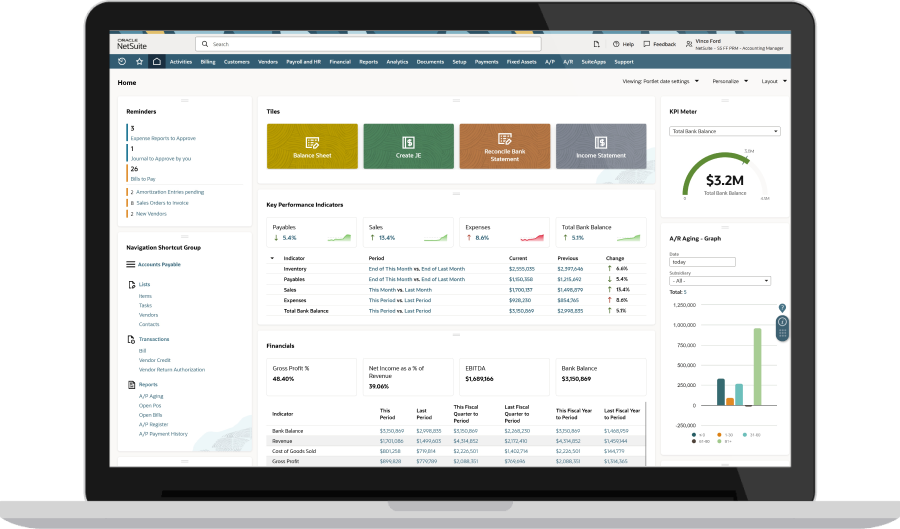
At a time when financial companies are under pressure to improve performance despite tighter margins, many are finding that cumbersome processes are impeding their performance. Disconnected financial, operational, and reporting systems can make it tough for leaders to identify inefficiencies and respond quickly to changing business needs. NetSuite ERP Software for Financial Services helps banks merge financial data and operational workflows into a more connected, controlled environment, giving leaders greater visibility into how the business is performing. AI-powered analytics adds another layer of insight by revealing patterns in spending, branch performance, and resource use that might otherwise go undetected, while automation speeds approvals, reporting, and other routine tasks.
NetSuite ERP Software for Financial Services
Many financial firms have institutional processes that have slowly become more complicated over time. Taking a closer look at how work moves through the company—and being willing to rethink long-standing ways of operating—often leads to opportunities to improve performance. Shortening loan approvals by a day, eliminating duplicated data entry, shrinking fraud investigation backlogs, and giving employees better access to information may seem like incremental gains, but over time these changes translate to a meaningful advantage.
Bank Operational Efficiency FAQs
Why is operational efficiency important for banks?
Operational efficiency lets banks cut costs, improve profitability, strengthen regulatory compliance, and deliver faster customer service. It can also allow institutions to scale operations and adapt to changing market conditions more easily.
Which technologies improve operational efficiency in banks?
Banks improve operational efficiency by harnessing several technologies, such as AI, agentic AI, robotic process automation, cloud computing, workflow automation, intelligent document processing, and ERP platforms. These technologies ease workflows, eliminate manual work, and provide a central repository of data for the entire business.