
Every company that exists today once had nothing to point to but an unproven idea. A bank can’t lend against that, and most venture funds won’t touch it, either. So who will write a check, before there’s any real proof the idea will work? That person is usually an angel investor. Understanding what they want, and where to find them, can turn a tech startup’s search for capital into a structured, achievable plan.
What Is a Tech Startup Angel Investor?
A tech startup angel investor is an individual who provides personal capital to an early-stage technology company—before it has revenue or a finished product—in exchange for equity or convertible debt. Individual checks often range from $25,000 to $100,000, according to J.P. Morgan, although the amount can run higher depending on the investor and the deal.
Key Takeaways
- Angel investors put their own money into early tech startups in exchange for equity, most often before the company has revenue or a finished product to show for it.
- Angels differ by type and motivation, ranging from individual operators who write small checks to organized groups that pool capital and expect a board seat.
- Founders usually find the right angel through professional networks, accelerator programs, angel groups, or online investment platforms.
- Angels typically look for a capable founding team and early signs of traction before writing a check.
Tech Startup Angel Investors Explained
A young company’s funding sources generally arrive in a predictable order: friends and family first, angel investors next, then venture capitalists (VCs), with check size inversely proportional to risk tolerance. Friends and family invest on trust, with little formal diligence. Angels usually invest on conviction. They back a founder and an idea before there’s much else to point to besides, maybe, a working prototype or a handful of early users. Together, these first two rounds often constitute the seed stage. Venture capital comes after, when a company can show real, sustained traction and justify the investment of someone else’s pooled capital.
This order isn’t fixed. Some founders skip family money and raise directly from angels. Others return to angels more than once before ever meeting with a VC. Whether a company is ready to approach the next tier of investor is determined by how much it can prove. Reasons why angels take that risk become important once a founder starts raising money.
Why Do Angel Investors Invest in Startups?
Return is part of the equation for angel investors, and the underlying math explains why they accept so much risk. Across venture and seed-stage investing broadly, the top 10% of companies have driven nearly 90% of the asset class’s total value, according to Cambridge Associates. That’s why angels build a portfolio including many companies; the rare winner that carries the whole return is impossible to pick out in advance.
US tax law further sweetens the return math. Stock that qualifies as Qualified Small Business Stock (QSBS) can exclude 50% of its capital gain from federal tax after a three-year hold—down from the previous five-year requirement—and the cap on how much gain a single investor can exclude per company rose from $10 million to $15 million, under a law that took effect July 4, 2025.
Money isn’t the only draw. Many angels are former founders or operators who want to stay close to early-stage building without running a company again. A founder they believe in is often reason enough to become involved. Some angels invest for more strategic reasons: Their checks buy an early look at a technology or a market that’s important to their own business.
Angel Investors vs. Venture Capitalists
In many respects, angel investors are similar to venture capitalists. Both provide capital in exchange for equity, and both depend on a handful of big wins to cover the losses on everything else in their portfolios. The differences lie in scale and structure. Angels invest their own money, usually in smaller amounts and at an earlier stage, while venture capitalists invest other people’s money through a formal fund and with a mandate to deploy much larger checks. The scale gap is real: According to the National Venture Capital Association (NVCA), US venture firms deployed $320 billion across more than 15,000 deals in 2025 alone, capital that flowed through a fund structure with partners and limited partners behind every check.
The difference in whose money is on the line shows up at the negotiating table. An angel can decide after a single conversation, while a VC’s check usually comes once a partner presents the deal to their own investment committee.
How Angel Investing Works for Tech Startups
Once an angel decides to invest, money and equity move in a fairly standard exchange, though what a startup gives up is often less obvious than what it gets.
What Tech Startups Get
The most visible benefit for startups that work with angel investors is capital, specifically the working capital a young company needs to hire its first engineers or keep the lights on before any revenue is generated. Capital has been getting more expensive to raise in percentage terms. The median seed-stage valuation on primary rounds hit a record $24 million at the end of 2025, up from $18 million a year earlier, according to equity management company Carta. That means a startup now has to be worth more to raise the same dollar amount without giving up extra equity.
Angels also bring their own experience. Many have built or run companies before, so a founder can lean on their backgrounds for advice a first-time founder wouldn’t otherwise receive. Angels can also introduce a founder to an early customer or the next investor in line.
What Angel Investors Get
In return for their money, angels get an equity stake, priced against the company’s valuation at the time of investment. If the company sells or goes public later at a much higher valuation, the return comes from that stake. A board seat is no longer a given, but angel groups that negotiate a board seat, or at least an observer role, have historically seen notably stronger returns, according to an analysis by Angel Capital Association (ACA) of one of its member’s deal records. When that angel group’s member held a board seat, they reported a 12.8 times return multiple on deals. When they didn’t, the multiple plunged to 0.9 times.
Investors also expect to receive regular financial reporting.
Types of Angel Investors
The type of angel investor a founder is talking to sets expectations for check size, industry focus, involvement, and speed:
- Individual angels are independently wealthy people who invest their own money into a handful of startups a year, usually guided by personal interest or connections. Decisions tend to move faster because the angel is free to act without having to consult a partner. Their level of involvement varies widely, from close mentorship to barely staying in touch.
- Domain angels are operators or executives from a specific industry who invest in startups within that field. They bring hands-on expertise a generalist investor wouldn’t possess. A domain angel who spent a decade in cybersecurity, for example, can spot a flawed threat model before a generalist investor would know which questions to ask.
- Super angels are high-volume individual investors who write enough checks, and often lead enough rounds, to function like a small, informal fund. However, they stop short of becoming an actual fund to avoid the regulatory and reporting duties that come with one. Even so, their deal volume gives them a wider view of a market than most single-check investors have, which is part of the reason other investors pay attention to which companies they back.
- Strategic angels are connected to larger companies and invest partly to gain early insight into a technology or market relevant to their own business. Their involvement can open doors at the larger company, too, whether that means an early pilot customer or a future acquisition conversation. Founders should expect sharper, more specific questions from this type of investor than from a generalist.
- Entrepreneurial angels are founders who’ve had a successful exit and want to reinvest some of that money into the next generation of startups. Because they were recently in the founder’s seat, these angels usually move quickly through diligence and skip questions a first-time investor might dwell on. Many stick to the same industry where they built their own company, since that’s where their judgment is sharpest.
- Passive angels, as the name suggests, are investors who write a check and step back. They offer capital without expecting a seat at the table or ongoing involvement. That hands-off style can suit a founder who already has enough active investors and mainly needs the capital.
- Angel networks are organized groups of individual angel investors who share due diligence. These groups generally organize one of two ways, either pooling money into a single vehicle where every member has to sign off on a deal or sharing deal flow but letting each member decide independently whether to invest. Both structures give members access to deals larger than any one of them could fund alone.
Angel Investor Benefits for Tech Startups
Beyond the capital itself, a good angel investor adds value a startup can’t easily find anywhere else:
- Industry insight and mentorship: Many angels have already built or scaled a company in the same space. That experience can help a founder avoid mistakes that might take months to learn the hard way.
- Early access to capital: Angels remain one of the few sources willing to write a check before a company has revenue; their money often becomes a startup’s first working capital. Per NVCA, pre-seed and seed rounds together drew $22.3 billion for roughly 5,000 US deals in 2025—the stage where angel money still does most of the work before larger funds get involved.
- Networking and connection: An angel’s own relationships, built over years in an industry, can put a founder in front of customers they wouldn’t be able to reach on their own or hires who would never take a cold email seriously.
Angel Investor Drawbacks for Tech Startups
Angel money isn’t free of trade-offs. Founders should consider these three drawbacks before taking money:
- Founder dilution: Dilution at the seed stage has held fairly steadily in the 19% to 20% range, even as round sizes have grown, according to Carta. This is partly responsible for pushing valuations higher. A company has to be worth more to raise a bigger round at the same dilution rate.
- Fit and alignment disagreements: An angel who disagrees with a founder’s pace or long-term plan can create friction that’s hard to undo once they’re already on the cap table.
- Additional complexity: Each new investor adds another relationship to manage and more paperwork that has to stay accurate as the company raises money later. Some platforms now bundle many small investors into a single line on the cap table specifically to cut down on that work.
What Tech Startups Should Look for in an Angel Investor
The right angel brings more than a check. Track records count for a lot. An angel who has previously built or exited a company has felt firsthand the same pressure a founder faces. Investment terms carry just as much weight. A separate ACA analysis of an angel network based in Texas found exits with a board member returned 9.5 times invested capital, on average, against 1.3 times for exits without one—a difference wide enough that founders should think carefully before agreeing to a deal structure that locks every investor out of governance. Angel groups are most likely to negotiate a board seat when a round totals $500,000 to $1 million, so founders who raise in that range should expect the topic to come up.
How to Find an Angel Investor for Your Tech Startup
Angels rarely advertise, so founders usually have to work several channels at once to find the right one. Here are seven places to look.
Professional Networks
Most angel checks still start with a warm introduction. Referrals from advisors and other founders who have already raised capital are often the fastest path to a first conversation because they inherently perform some of the credibility work a cold pitch can’t.
Tech Startup Events
Pitch competitions and industry meetups provide value beyond the day of the pitch itself. Relationships that founders make there, even without an immediate investment, often resurface later in a round.
Angel Groups
Organized groups vet deals through a shared process. The full membership weighs in before anyone invests. The ACA’s own description of the process shows how much filtering happens along the way: After an initial screening, only about 10% to 25% of applicants advance to a full pitch; of those, only 25% to 50% ultimately get funded. A single pitch to a group can still reach dozens of potential investors at once, making groups a more efficient path than chasing individual angels one at a time.
Tech Accelerators and Incubators
Tech startup incubators and accelerators, such as Y Combinator and TechStars, connect founders directly to investors as part of the program itself. Y Combinator’s own standard deal invests $500,000 in every company it accepts—$125,000 for a fixed 7% stake and the remaining $375,000 on an uncapped note that converts on the terms of whatever round comes next.
Targeted Outreach
Some founders build a list of angels who have previously backed similar companies to whom they then reach out with a short, specific pitch. This approach requires more up-front research, but founders who include within the pitch a reference to the angel’s past investments give themselves a better chance of getting a reply.
Investment Platforms
Investment platforms, such as AngelList and Wefunder, let founders raise from many small investors at once by bundling them into a single entity that shows up as one line on the startup’s cap table. Results vary widely, depending on how the deal is presented on the platform. In seed deals from 2025, only 26% of the entities a founder set up alone ended up collecting and delivering the money to the company, according to AngelList’s data. But when an experienced early investor set up the deal instead, the success rate jumped to 65%. Among the entities that did close, though, the outcomes looked about the same regardless of who started them, with similar valuations and comparable returns.
Individual Introduction
A single respected angel who says yes often piques other angels’ interests. Their willingness to invest works as a signal to the next investor that someone who has seen many pitches decided this one was worth the risk.
What Angel Investors Look for in a Tech Startup
Angels don’t invest in most of the pitches they receive. Indeed, a startup has to clear a high bar before it receives funds.
Founding Team and Founder-Market Fit
Early-stage investing places considerable weight on the founding team because there’s rarely enough traction at that point to judge the business on numbers alone. Angels look for founder-market fit—direct, personal experience with the exact problem a startup is solving—plus evidence that the team can execute on the plan they’re pitching.
Product
An early product doesn’t need polish. Rather, angels want proof of real users who engage with it and a team that keeps improving it, based on what those users do.
Traction and Growth
Traction is the clearest evidence a startup is on the right path, whether that translates as paying customers or increased monthly revenue. Growth also determines what comes next, but fewer startups are clearing that hurdle. Only about 17% of startups that raised a seed round in 2022 went on to raise a Series A within two years, down from 25% to 30% in stronger fundraising years, according to Carta.
Opportunity and Market Demand
Right now, market opportunity mostly means one thing: AI. More than 70% of global startup capital in the second quarter of 2026 went into AI-focused companies, up from just under half a year earlier, per Crunchbase. A founder outside AI needs an equally clear, specific answer for why their market and their timing make sense.
Business Model
Few pre-seed startups have paying customers yet, so what angels are really testing is whether a founder has a credible theory for how the company will eventually make money. A founder who can walk through pricing and unit economics and can point to clean financial statements gives an angel faith that the business has been thought through. Clear financial reporting as the company scales is also important, because it’s how that faith gets tested after the check clears.
Investment Opportunity
AI’s share of US venture deal value climbed from 50.9% in 2024 to 65.4% in 2025, according to NVCA. Startups that can show capital efficiency, not just an AI label, have an easier time justifying their valuation.
Are Your Finances Ready for Investors?
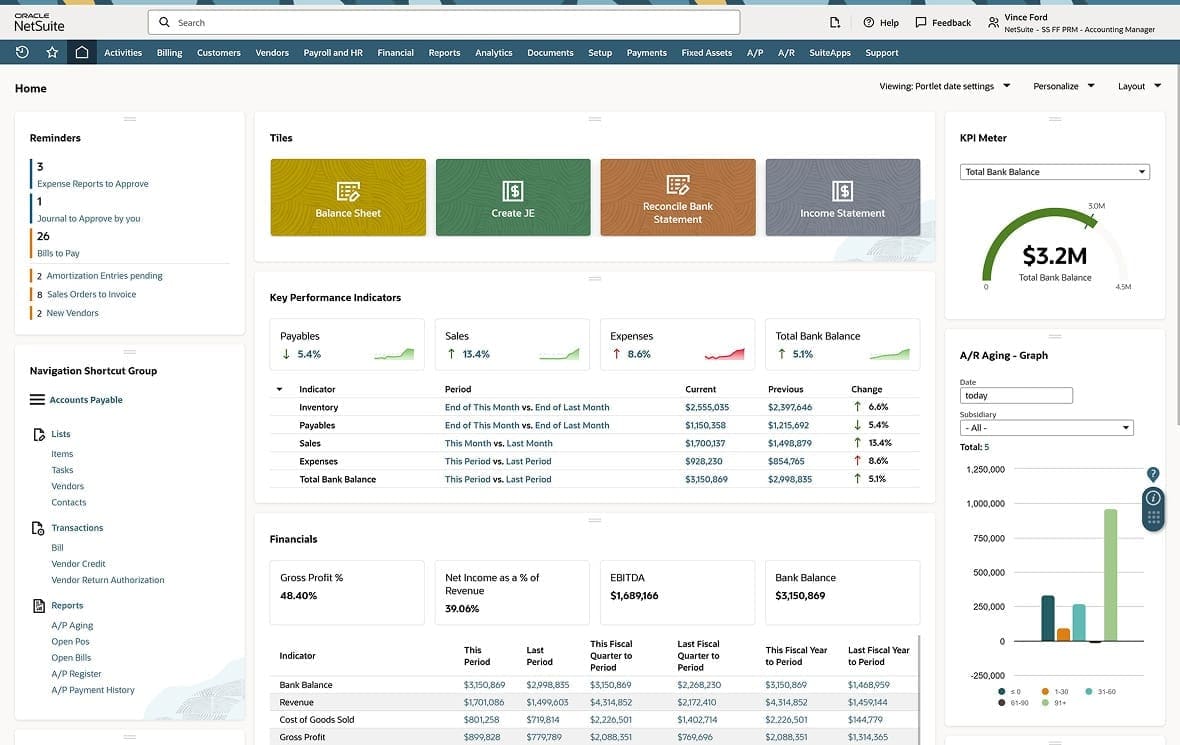
Every angel conversation eventually turns to the numbers. Startups that still run on spreadsheets often struggle to answer even basic questions about cash runway and how revenue is trending month to month. NetSuite Financial Management gives growing companies a single, real-time view of their finances. AI-powered tools, such as Narrative Reporting, turn raw financial data into plain-language summaries of what’s driving the numbers, while Predictive Planning builds forecasts and lays out the reasoning behind them. That gives a founder something concrete to walk an investor through.
Real-Time Financial View
Every check an angel writes is a bet that someone else hasn’t made yet. The mechanics, the pitch deck, the terms, and the intros all play a role, but they exist to help one person—or one small group—decide they believe in a founder enough to go first. That decision changes the odds for everyone who comes after. Other investors read an early angel’s involvement as proof that someone who saw the company up close was willing to bet on it before the rest of the market would.
For startups that aren't quite ready for a full financial management suite, NetSuite's QuickStart delivers an AI-powered accounting platform ready for angel investment opportunities. QuickStart brings automation to balance sheets, invoices, subscriptions, and more, giving startups a real-time look at the numbers critical to winning over angel investors, all through a conversational interface connected to the AI you already use.
Tech Startup Angel Investors FAQs
What is the primary benefit of seeking angel investment for a new startup?
The biggest benefit is access to capital at a stage where almost no other funding source will take the risk. Angels also bring experience and connections that can be worth as much as the money itself, especially for a founder raising money for the first time.
How do I find the best angel investor for my tech startup?
Start with people already in your network, such as advisors or founders who have raised money before, because a warm introduction usually outperforms a cold pitch. From there, angel groups and investment platforms widen the search to investors outside your immediate circle.
What percentage does an angel investor take?
There’s no fixed rule, but a common benchmark is around 7% to 10% of the company for an early check, similar to the fixed 7% stake Y Combinator takes for its standard $125,000 investment. The exact stake depends on the round’s size and the company’s valuation at the time, so the same dollar amount can mean a very different percentage from one startup to the next.
Where do I get funding for a tech startup?
Beyond angels, tech startups typically raise from friends and family, accelerators, venture capital firms, or crowdfunding platforms. The mix depends on the stage and how much traction the company already has. Most founders end up combining more than one source over time.