
Investment banks have long used robotic process automation (RPA) for their simplest, most repetitive tasks but resisted automating the messier, judgment-heavy work. That resistance is fading now that intelligent document processing and AI agents can handle unstructured files, document reviews, and regulatory compliance, freeing bankers for higher-value work.
What Is Automation in Investment Banking?
Automation in investment banking refers to the use of software, algorithms, and AI to perform tasks that once required a person to read, calculate, compare, or route. It spans the front office, where deal teams manage origination and execution; the middle office, which covers risk and compliance; and the back office, which handles trade settlement, reconciliation, and reporting.
Key Takeaways
- Automating document review and compliance monitoring gives investment banks faster turnaround times and more room for judgment-driven client work.
- From deal document production to post-merger integration tracking, automation now touches nearly every stage of the investment banking lifecycle.
- Coordinated AI agents that manage entire workflows are leading banks to rethink how they govern automated decisions.
Automation in Investment Banking Explained
Automation ranges from simple, rules-based tools that move data between systems to complex AI agents that reason through multistep workflows. Investment banks want automation to handle a growing amount of document and data work, so they can do more business without adding corresponding headcount. Multiple technologies work together to make that possible:
- RPA mimics a person’s clicks and keystrokes, and it works best on high-volume, repeatable tasks.
- Intelligent document processing (IDP) combines optical character recognition and natural language processing to read and extract information from documents.
- Machine learning models score risk and detect anomalous trading activity using historical data.
- Generative AI (GenAI) drafts and summarizes text using a bank’s documents.
- AI agents plan, carry out, and verify workflows with limited human direction, drawing on context to handle unscripted situations.
Many banks use hyperautomation—combining multiple technologies under one governance and monitoring framework—to automate as many business processes as possible. The same shift is playing out in CFO automation, where finance teams consolidate automation tools into one coordinated strategy.
Investment banking presents a harder automation environment than retail or commercial banking. No two merger mandates, bond issuances, or restructuring engagements look exactly alike, so rigid, hard-coded rules tend to break down. Decades of mergers mean many large investment banks run numerous legacy systems with disconnected data models, complicating automation efforts. And much of the information that drives investment banking decisions, such as confidential information memoranda and board minutes, exists in unstructured documents that require extraction before automation tools can act on them.
Advantages of Automation in Investment Banking
Automation’s benefits compound as they move through a bank’s operations. Faster document turnaround creates room for tighter compliance processes, cleaner data leads and sharper insights. Here’s where automation delivers value for an investment bank:
- Reduced turnaround times: Automation can compress manual document review into a matter of hours, letting deal teams move faster from mandate to execution.
- Productivity gains: With automation handling repetitive document and data tasks, analysts and associates recover time for modeling, structuring, and client work that requires their expertise.
- Compliance monitoring and risk reduction: AI-based screening can reduce false compliance alerts by comparing transactions with a client’s typical activity. This helps compliance teams focus on higher-risk cases
- Enhanced institutional knowledge capture: By converting unstructured data, such as meeting notes, deal memoranda, and client histories, into structured data, knowledge becomes searchable and accessible to an entire coverage team.
- Improved insights: Analysts can use AI to monitor internal and external data for stalled deal pipelines, market shifts, and other insights that demand urgent attention.
- Greater customer satisfaction: By cutting onboarding time and reducing false compliance alerts that delay legitimate transactions, automation shapes how clients experience the banking relationship.
10 Automation Uses in Investment Banking
Automation touches every stage of the investment banking lifecycle, from the first draft of a pitch book to the integration work after a closed deal. Some use cases automate a single task, such as reading a legal document, while others coordinate an entire workflow.
-
Deal Document Production
From confidential information memoranda to credit agreements, deal documents typically follow a similar structure that is ripe for automation. For example, IDP can extract negotiated deal terms and check them against a bank’s standard precedent language, so an analyst or lawyer doesn’t need to read each one. And GenAI tools can produce first drafts that a banker can review and refine. These capabilities can reduce the time and manual effort required to produce deal documents.
-
Client Onboarding Bottlenecks
Manually collecting and verifying KYC/AML documentation for new clients is one of investment banking’s most visible bottlenecks. Automating these tasks—including pulling identifying details from a client’s documents, checking them against sanctions and watchlists, and scoring the file against a bank’s risk criteria— can reduce end-to-end onboarding processing time by 32% in the first year in a Tier 1 bank scenario modeled by Chartis Research and Encompass.
-
Financial Crime Surveillance
Financial crime compliance includes scrutinizing transactions, screening sanctions lists and watchlists, and monitoring clients for negative news. AI-driven surveillance platforms apply behavioral analytics to client and transaction context, catching suspicious activity while reducing the volume of false-positive alerts that need review. IDP also helps investment banks meet regulatory transition deadlines—for example, scanning older agreements to identify references to a retired benchmark. Combined, these tools give compliance teams a focused queue of alerts to work through each day.
-
Financial Close and Reconciliation
The period-end financial close involves reconciling general ledger balances, substantiating account balances, matching intercompany transactions, and preparing financial statements. Continuous accounting platforms automate reconciliation and substantiation throughout the period, matching transactions as they occur and identifying genuine exceptions for further review. This lowers close cycle labor costs and the risk that a manual transcription error will propagate into a misstated balance.
-
Regulatory Report Automation
Investment banks operating in multiple jurisdictions must produce a continuous stream of regulatory reports, each filed against a different authority’s schedule. RegTech platforms connect directly to source systems and apply validation rules to catch discrepancies, such as inconsistent figures or incomplete fields, before a report reaches a regulator, backed by a complete audit trail.
-
Client, Contact and Deal Data Unification
A coverage team’s most valuable data—who bankers know, what they’ve discussed, and which deals are in motion—is often scattered through inboxes and spreadsheets. Purpose-built CRM platforms automatically capture this relationship and deal data into one continuously updated and shared record. This clean, centralized data also supports AI-assisted deal sourcing and relationship intelligence, such as suggesting a relevant contact, warning when two deal teams are approaching the same target, or recommending cross-selling opportunities.
-
Fee Invoicing and Expense Recovery
Investment banking engagements often combine several fee structures—retainers, milestones, success fees, and expense reimbursements—within a single contract. Automated earnings, billings, and collections reconciliation extracts fee and expense terms directly from engagement letters and checks them continually against deal status. It also catches milestone fees the moment they hit to prevent revenue leakage. It matches reimbursable-expense documentation to the right client agreement, a core expense management task banks often miss, directly improving realized fee revenue.
-
Trade, Settlement, and Reconciliation Exceptions
In the US, the standard settlement cycle for most broker-dealer transactions moved to T+1 in May 2024, increasing pressure to complete allocations, confirmations, and affirmations on trade date. Exception management and reconciliation platforms can validate and match data throughout the trade lifecycle, helping operations teams identify and resolve breaks quickly. Automation can help teams manage the tighter settlement window and reduce reliance on manual reconciliation.
-
Financial Model Data Ingestion
IDP can handle much of the administrative work behind building and maintaining financial models, be it a public company comparison built from regulatory filings or a private market model built from fund documents. These tools can extract line items directly from public filings into structured, model-ready formats, freeing analysts to focus on interpretation. In private markets with less standardized documents, specialized platforms extract and structure data before feeding it into portfolio management and reporting systems. The goal is faster model turnarounds and fewer transcription errors.
-
Post-Merger Integration Tracking
An investment bank’s advisory work on a merger typically ends at closing, but the months that follow determine whether the deal lives up to its investment proposition. McKinsey found that 79% of large deals that outperformed their market index in the first 18 months were still above the index three years after close, putting a premium on disciplined integration and real-time visibility into workstreams and milestones. Post-merger integration platforms centralize tracking, even when integrations span workstreams and geographies. This automation provides a continuously updated view of financial and operational progress, giving the bank concrete evidence of its role in synergy capture when pitching new business.
Emerging Trends in Investment Banking Automation
The next phase of investment banking automation focuses on orchestrating entire workflows through coordinated AI agents, which are increasingly used in accounting and other finance functions. Front-office and deal-related workflows are highly specialized and full of exceptions that break rigid, rule-based systems. AI agents built with planner, execution, and verification roles can reason through each case on its own terms. Research publishing, trade exception management, collateral processing, securities settlement, and regulatory reporting are expected to see significant impact from this shift.
At the same time, GenAI is beginning to move from department-level pilots to firmwide infrastructure, typically as a general-purpose assistant layered on top of a bank’s own documents and knowledge base. Banks are relying on data protection arrangements with their AI providers as baseline governance requirements. As automation and AI agents take on larger roles, banks are extending model risk management frameworks to cover them, and verifier agents will increasingly check an agent’s output before it’s finalized.
Automation is also changing the role of junior bankers, who traditionally learned the business by doing work now handled by automation, such as document review, comparable company modeling, and memo writing. According to McKinsey, junior-level analysts and associates may end up managing “squads” of specialized AI agents—a move likely to reshape team structures.
Modernize Investment Banking Operations With NetSuite ERP
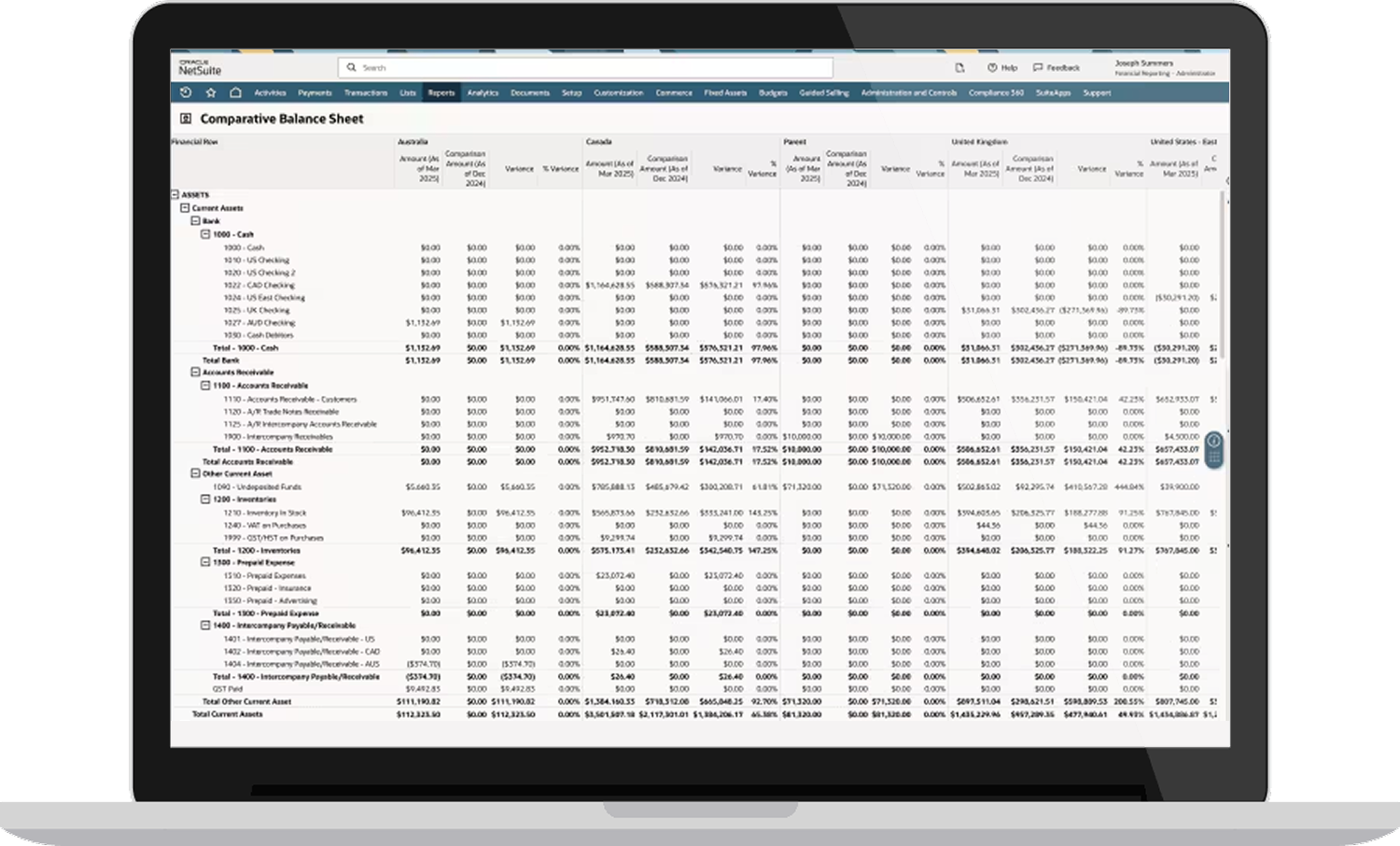
Investment banks juggling fragmented legacy systems and regulatory complexity don’t need to solve each pain point with a separate tool. NetSuite ERP Software for Financial Services brings finance, operations, and compliance data into one cloud-based system, automating ledgers and reconciliations to speed the financial close, even as the organization grows. Role-based access control, segregation of duties, and audit trails help banks document control activity for internal and external review. For banks operating across jurisdictions, built-in multicurrency and tax capabilities can reduce manual reconciliation across entities and tax regimes. ERP’s unified data also gives AI features a consistent financial-data foundation. NetSuite Narrative Insights delivers AI-generated explanations of trends, and Autonomous Close identifies exceptions as they emerge. Banks with developer resources can extend this further with SuiteAgents, NetSuite’s framework for building custom AI agents that use approved tools and permission boundaries inside NetSuite workflows.
Manage Multiple Entities with NetSuite
Automation in investment banking has evolved from single-task RPA into a layered stack that operates throughout the organization. None of this removes bankers or analysts from the process. Instead, it lets them focus on the work that requires judgment. The next phase—AI agents that can own an entire workflow, from intake through a final decision—will compress processes that once required several handoffs between people and systems into one continuous, largely automated line.
Automation in Investment Banking FAQs
Can investment banking be automated?
Much of investment banking’s document-heavy, repeatable work, such as data extraction, reconciliation, and compliance monitoring, can be automated. The judgment-intensive parts of the job, such as structuring a deal or advising a client through a negotiation, still require a person.
Can automation improve efficiency in investment banking?
Yes, automation can improve efficiency by reducing manual work in document review, client onboarding, and reconciliation. It can also reduce false-positive alerts that slow compliance teams.
What is an example of successful intelligent automation implementation in finance?
Intelligent automation tools can convert recorded client meetings into structured notes, enter them into the CRM, and draft follow-up communications for financial advisors to review. Another example of successful intelligent automation is firm-wide GenAI assistants used for drafting, summarizing, and research.