
Fintech lenders and one-tap checkout financing have trained borrowers to expect a loan decision in minutes. A small-business owner applying for working capital now anticipates an answer before lunch, even from a community bank or credit union. That assumption runs headlong into the reality inside many lending operations, where disconnected legacy systems and manual reviews can slow every decision and let mistakes slip through. Digital transformation helps lenders address the disconnect between what borrowers want and what their systems can deliver.
What Is Digital Transformation in Lending?
Digital transformation in lending is the shift from manual, paper-based loan processes to software-driven workflows built on cloud infrastructure and artificial intelligence. These technologies span a loan’s full life cycle, from the first online application through underwriting, funding, servicing, and repayment.
Digital transformation runs deeper than swapping paper for screens. It requires rethinking how a lending business operates efficiently, such as how it greets an applicant online, prices risk, and documents compliance. When all the digital pieces come together, a loan application keeps moving, with each stage drawing on data the previous one captured.
Key Takeaways
- Digital transformation in lending replaces manual, disconnected steps with integrated systems built on cloud infrastructure and AI.
- Adoption is climbing because borrowers want faster decisions and lenders want lower costs and better risk control.
- AI agents and predictive analytics are advancing from the pilot stage into live credit and fraud work.
- Trusted, connected data is the foundation that makes digital improvement possible.
- Delaying transformation raises competitive and regulatory risk.
Digital Transformation in Lending Explained
For most lenders, the push to modernize begins with a growing tension between what borrowers expect and what lenders’ systems can do. Legacy systems still assume paper files and manual handoffs will be prevalent, despite borrowers having moved to digital speed. That tension shows up as slower approvals and higher costs. The possibility of risk arising from disconnected systems also builds until it becomes unavoidable.
The lending segment of financial services digital transformation brings together the individual pieces of the loan process. When an application, an income verification, a credit decision, and a servicing record all draw from the same data, a lender can approve worthy borrowers faster and catch problems sooner. The business case is often grounded in two benefits: increased speed that keeps customers from walking away and automation that takes cost out of every loan.
Digital transformation isn’t a single software purchase. It’s typically a multiyear effort a lender works through in stages, with a sequence defined by internal goals. It is also built on trustworthy, connected data. Therefore, the discipline required to govern the underlying data matters as much as the technology selection.
Why Leading Lenders Are Investing in Digital Transformation
Investment in digital lending has evolved from experiment to expectation, and borrower behavior is a big reason why. A case in point: The share of small businesses seeking financing from online fintech lenders climbed from 17% in 2020 to 29% in 2025, according to a 2026 Federal Reserve report.
Lenders that meet that demand will be better positioned to win business. And the advantage builds from there. Institutions that combine cloud infrastructure with AI in financial services produce faster, less-expensive decisions because their models work from one connected set of data. Accenture’s 2025 banking index finds that large banks moving fastest to connect cloud and AI to business performance lift return on equity by an average of 125 basis points and cut cost-to-income ratios by 452 basis points.
There’s also a risk management angle to consider. The downside: Moving lending to digital, self-service channels raises fraud exposure because remote applications remove the in-person checks that once caught bad actors. What’s more, criminals now use AI to submit multiple fake and synthetic-identity applications. However, modernization can supply the countermeasure, such as through AI-based detection that screens applications as they arrive and helps catch suspicious ones before a loan is funded.
The Potential Consequences of Delaying Digital Transformation
A lender continuing to run its core on legacy technology pays to maintain aging systems as competitors pursuing digital transformation programs pull ahead on speed and insight. Just 10% of core banking workloads have moved to the cloud, according to Accenture’s 2025 banking study, which calls core modernization the industry’s single biggest untapped source of value. Waiting also increases regulatory exposure, since compliance depends on accurate reports and complete audit trails. Disconnected tools with manual reconciliation make those harder to produce—a drawback when a single lapse can draw an examiner’s scrutiny. The competitive cost of delay is just as consequential. Borrowers often choose whichever lender answers first, and a firm that can’t keep pace may lose business to quicker competitors.
Major Digital Transformation Technologies
Digital transformation in lending typically involves multiple technologies that share the same data and work together to deliver more value. These five digital technologies are foundational to lending transformation efforts today.
AI and Agentic AI
In lending, AI touches most parts of the loan lifecycle, but the type depends on the task. Machine learning models extract data from documents and identify fraud patterns, while generative AI handles borrower communication, such as status updates and document requests. Agentic AI workflows carry out multistep tasks, such as gathering data, running risk models, and noting exceptions, all enacted within a lender’s existing approval rules, including having a human available who is accountable for decision-making.
Predictive Analytics
Predictive modeling uses historical and alternative data, such as cash flow or rent and utility payment history, to forecast borrower behavior. This allows lenders to approve strong applicants with little credit history that a conventional score would reject. Prediction quality depends on data quality—with clean, connected records, a predictive model can spot repayment risks a manual review would miss, while fragmented data may produce untrustworthy output. In servicing, these signals can alert lenders to struggling borrowers in time to offer an alternative or, for dependable customers, identify the right time to recommend a refinance or cross-sell.
Cloud Architecture
Cloud computing underpins the full digital transformation stack by supplying the on-demand computing power that real-time decisions and AI growth require. The bigger gain now is capability, not the cost savings that were once the cloud’s selling point. Lenders without that foundation can’t match competitors’ fast, data-driven features. Adoption remains uneven though: Many banks still use a single cloud provider, risking ripple effects from an outage or price hike. As a result, migrating core workloads off legacy systems becomes a multiyear project most lenders have just started.
Workflow Automation
Workflow automation eliminates slow, error-prone manual handoffs. When a document arrives, the system gathers data, checks it against policy, and routes exceptions to a person so straightforward cases move quickly, while experienced staff handle harder judgment calls. The payoff is biggest on a lender’s highest-volume, most repetitive work. But automation workflows must be able to flex to match the loan, rather than treating every one the same. A rigid, one-path process reintroduces the delays it was meant to remove.
Application Programming Interfaces (APIs)
APIs let separate systems exchange data automatically, pulling in a credit score, verifying income, or serving an embedded lending platform. But each API is also an entry point, so a lender’s information security is only as strong as its least careful partner. Also, the rules governing consumer data access remain unsettled. The Consumer Financial Protection Bureau finalized its Section 1033 open banking rule in 2024, a federal court blocked enforcement, and the CFPB is now rewriting it, leaving lenders building API strategies based on requirements that could still change.
Benefits of Digital Transformation in Lending
Digital transformation pays off for lenders and borrowers. Cleaner data and faster processes lower a lender’s costs while giving a borrower a quicker, simpler experience.
Benefits for Lenders
A lender’s biggest gains come from moving data out of separate tools into a single connected system. Faster decisions, easier compliance, and bottom-line savings follow:
- Centralized architecture: ERP-based digital transformation replaces a patchwork of tools requiring manual data entry and records reconciliation with one current view of the business.
- Faster loan processing: Automated data capture and decision-making cut the time between application and answer from days to minutes for straightforward loans.
- Improved compliance: A connected lending system records each decision as it happens, capturing the approver’s name, the supporting data, and a complete audit trail, so documentation is ready for an examiner’s questions.
Benefits for Borrowers
Borrowers rarely see the systems behind a loan, but they feel modernization’s results in how their business is handled:
- Enhanced customer experience: Applications that once required a branch visit and a stack of forms happen online with fewer steps and a faster answer.
- Increased personalization: Lenders can draw on richer data to match products and terms to each borrower’s real situation.
- Improved transparency: A borrower can see where an application stands and what shaped the decision.
Emerging Trends in Lending Digital Transformation
Real-time credit decisions are now standard practice, but a few financial services trends are gaining steam. Dynamic personalization lets lenders use live data to build customer segments instantly and tailor offers to each person, while embedded lending puts financing options inside a retailer’s online checkout or a small business’s invoicing software. AI agents, currently running defined, multistep tasks under human oversight, will take on more sophisticated workflows next. And as fraud rises, more lenders—including credit unions and community banks that have historically lagged behind larger competitors—are investing in AI-based detection out of necessity.
Getting Started With Digital Transformation in Lending: 3 Key Tips
Before selecting software, lenders must lay the groundwork—namely, the technology and processes that underpin digital transformation. Three steps matter most at the outset:
- Define modernization objectives and success metrics: Successful programs start by defining their most pressing problems, then set measurable targets for solving them. Otherwise, projects can drift, and it’s hard to tell progress from activity.
- Prioritize compliance and security measures: Security and compliance can’t be bolted on at the end. Access controls and audit trails must be built in from the start, before an oversight becomes a breach.
- Coordinate roadmap with key stakeholders: Modernization touches lending, IT, risk, and the front line, so a modernization roadmap factors in those needs and constraints from the start.
Successful Digital Transformation Starts With Trusted Data
The hardest part of digital transformation in lending is getting data out of disconnected systems and into one place where it can do useful work. NetSuite ERP Software for Financial Services puts accounting, loan records, and reporting on one cloud platform so automation has clean, current data to draw on. Anomaly detection watches transactions for unusual patterns, and autonomous close keeps reconciliations and the month-end close current. Ask Oracle lets a finance team ask questions in plain language and get correctly sourced answers. And AI agents work inside the lender’s existing back-office roles and approvals to build a record for auditors. Together, these capabilities let a lender move at the speed borrowers expect while maintaining the control regulators require.
Integrated Governance Capabilities for Lenders
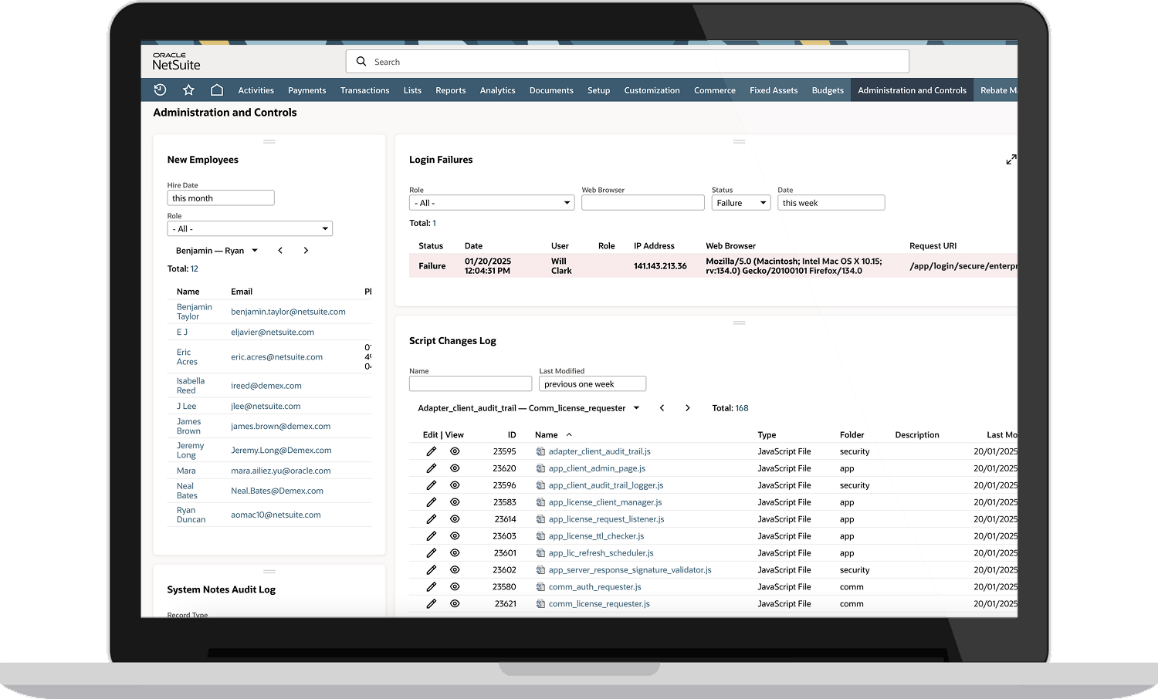
At its core, digital transformation in lending is a data problem. The mobile app and the AI model work when clean data can move directly from an application to a funded loan. The groundwork that underlies it is unglamorous but critical; everything is built on top of it. The data also shapes what a lender can do next. Borrower expectations—and the tools to meet them—keep changing, and a unified data platform helps lenders adopt each new capability as it arrives.
Digital Transformation in Lending FAQs
Why does digital transformation matter to lenders?
Digital transformation matters to lenders because it lets them make decisions faster and smarter, spend less on each loan, and manage risk with better data than legacy systems allow. It also strengthens competitiveness by offering the digital experiences borrowers expect.
What are the biggest challenges of digital transformation in lending?
The biggest challenges of digital transformation in lending are untangling decades-old core systems and moving the data they contain without disruption. Close behind are the governance and security demands of a regulated industry, where a rushed rollout can create as much risk as it removes.