
Tech startups often find themselves in a race against time to turn a promising idea into a viable business before funding runs out and the market moves on. That requires founders to overcome several obstacles, including proving demand for their products, managing limited cash, competing for investors and customers, and making technology decisions that will support the business as it grows—all while navigating an industry that can change on a dime.
This article examines 10 significant challenges tech founders face, along with practical strategies to set the business up for success.
Key Takeaways
- Raising money is becoming more challenging, as investors increasingly want to see evidence of customer demand and a credible path to revenue.
- In addition to confirming a good product-market fit, startups have to figure out how to differentiate their offerings amid steep competition.
- Tech startups often need to hire talent with specialized skills in AI and security—areas where larger companies may offer higher compensation.
- Scalable technology can help startups avoid costly platform upgrades as the business grows.
The 10 Biggest Challenges Facing Tech Startups Today
Technical expertise may help a startup build a solid product, but can the company survive long enough to turn that promise into a thriving business? Founders have to prove there is genuine demand, secure enough capital to sustain operations, and differentiate their products and services in a competitive market. Those hurdles are particularly pronounced in 2026, as startups contend with rapid technological change and growing pressure to demonstrate a path to profitability.
-
Stricter Fundraising Standards
Investors have become more selective about the companies they back, making it tough for startups to raise capital based on an intriguing concept alone. Due diligence that once followed a term sheet increasingly occurs beforehand, as investors ask early-stage founders for retention curves, cohort data, and a credible path to efficient, sustainable revenue growth. That increased scrutiny is evident in the time it takes startups to reach the next funding round. The typical seed-to-Series-A timeline now stands at two years, up from 616 days in mid-2025 and well past the 18-month runway many founders planned around just a few years ago, according to Carta. This doesn’t imply capital is scarce. US venture investment hit a record $412.7 billion in the first half of 2026, according to a report by PitchBook and the National Venture Capital Association. But a small number of enormous rounds concentrated in AI drove that total, not broadly improved conditions for early-stage companies.
-
Product–Market Fit
A product or service can work perfectly, yet still fall flat if customers don’t see enough value in it. For tech startups, the challenge is finding product-market fit—the point where a product solves a meaningful customer problem well enough that people are willing to pay for it and keep using it. That’s harder to judge than it sounds. For example, a SaaS startup can generate plenty of free-trial sign-ups and enthusiastic first impressions, and read that response as proof of real demand. But interest isn’t the same as making a financial commitment. The more reliable signals come later, when customers decide whether to renew, pay more, or build the product into their daily workflows. Getting product-market fit wrong can be expensive; it’s cited as a primary reason for failure by 43% of VC-backed startups that have shut down since 2023, according to CB Insights.
-
Increased Competition and Market Pressures
The tech landscape can be tough for startups to crack, especially in categories where AI has drawn significant capital and intensified competition. AI has also decreased how long a feature stays differentiated. A well-funded rival watching a product gain traction can brief an engineering team to rebuild the same core functionality using AI-assisted coding tools, compressing a rebuild that once took three months into weeks. That reality pushes a company’s long-term advantage away from the product itself and toward elements that a fast follower can’t easily copy, such as proprietary customer data or established distribution relationships. At the same time, economic instability may make customers and investors more cautious about where they put their money.
-
Scaling for Rapid Growth
Growth is the goal for most startups, but scaling to meet demand raises challenges in hiring, systems, and spending that are easy to underestimate. Many tie this to the founder becoming a bottleneck, after it is no longer practical for that person to be involved in every single decision. Yet giving up control can be tough, especially for owners with little experience in managing staff. Additional problems that may crop up during rapid growth include hiring faster than the business can onboard people well (see #6), relying on systems built for a smaller company that strain under new volume (see #7), and burning through cash faster than the business can sustain (see #10). Scale before new processes exist and costs can spiral; wait too long to build them and customers feel the slowdown.
-
Brand Differentiation
In crowded tech markets, new businesses often compete less against other startups than against much larger, better-funded incumbents that offer similar-sounding promises with bigger marketing budgets behind them. When the underlying products aren’t much different, buyers tend to respond more to how specific and credible a claim sounds. A small workflow-automation startup competing against an established enterprise suite, for example, can’t match the incumbent’s longstanding reputation and breadth of features, but it can out-focus the bigger company by building its entire pitch around the one problem it solves better. Consider Zoom, which soared in popularity by providing easy, reliable video calls better than any of its Goliath-sized rivals that treated videoconferencing as one feature buried inside bigger products.
-
Hiring and Retaining Top Talent
Tech startups are competing with larger, better-funded companies that typically offer higher compensation and greater name recognition, leaving them with a smaller pool of candidates to pursue. Retaining employees can be just as challenging. According to a Dice survey of US tech professionals, workers at companies with fewer than 250 employees—a category that includes most startups—show some of the highest employee turnover risk, for reasons including burnout, layoff worries, and low confidence in job stability.
-
Building Sustainable Architecture
Under pressure to meet immediate business needs, tech startups may view one-off technical integrations or AI coding tools as the fastest workaround. But a company can adopt a quick fix without clearly understanding whether it fits well with existing code, handles edge cases correctly, or can be easily changed later. When these short-term decisions accumulate, a business can end up with disconnected systems that can’t scale without rebuilding core systems.
-
Filling Critical Expertise Gaps
Tech startups often have ambitious business plans but may lack the specialized expertise within a small, early-stage team to execute them. Demand for security, compliance, and AI skill sets are particularly common pressure points. According to Ashby’s 2026 “State of Startup Hiring” report, roughly one-third of job postings at venture-backed startups now mention AI, and the share of startup job titles containing “AI” has doubled in the past two years. A time-consuming recruitment process can also impede hiring, since many early-stage startups don’t have a dedicated recruiting team. Per Ashby, it takes about 21 hours of interviewer time and interviews with 18 candidates to fill a single technical role at a startup with fewer than 25 employees.
-
Customer Acquisition Costs
Customer acquisition costs can add up quickly for tech startups that are trying to win business in crowded markets dominated by well-known competitors. With limited brand recognition and small sales and marketing teams, startups often have to invest more time and effort to earn a prospect’s trust. Selling complex software, for instance, might require product demonstrations, proof-of-concept pilots, security reviews, and conversations with multiple decision-makers before a deal is approved. These longer sales cycles can increase the cost of each customer acquisition, which means the startup may not recover its investment until long after the customer has signed.
-
Long-Range Planning and Focus
Making long-term commitments without a predictable revenue stream carries considerable risk. New businesses are often deciding what to build next, which technical architecture to invest in, who to hire, and which customers to prioritize with limited proof of what will actually work. Funding is typically limited as well, which means the company has little room to absorb a costly wrong turn. At the same time, a startup can easily lose focus as new feature ideas, customer requests, partnership opportunities, changing market expectations, and the daily challenge of running the business compete for attention. Strong strategic planning involves maintaining enough focus to build a solid product and customer base, yet remaining open to feedback that may indicate the company needs to adjust its plans.
Strategies for Founders: 3 Tips for Success
Many of the challenges above trace back to the same root causes: moving forward without enough evidence, spending faster than the business can sustain, or building without a plan for what comes next. The following three strategies help tech startups take aim at each of those shortcomings.
-
Validate Early
Developing a strong business idea is the obvious first step, but rushing to market with a product or service nobody needs can be costly. Before investing too much time or money, startups can talk to customers about the problem they’re attempting to solve, then test the idea on focus groups using a simple prototype. Feedback helps identify what does and doesn’t work and whether people are willing to pay for the solution. Homing in on how users interact with the product can also inform refinements. This same discipline applies after launch, too, to help validate a new feature, customer segment, or market. Don’t assume early success with one group of customers will automatically carry over to the next.
-
Be Intentional With Finances
Underestimating cash runway and poor forecasting are the most common financial blind spots that slow startup growth, according to a 2026 TechNation survey of tech founders and startup leaders. Every dollar counts when building a new business, so founders should develop a well-thought-out plan for using resources and closely monitor cash flow. Spending on factors that directly support growth, such as product development and customer acquisition, should take priority over expensive office leases, excessive travel, and other expenses that don’t directly align with revenue and product development. Frequently conducting cash flow analyses can help startups assess whether spending is moving the business forward.
-
Lay the Right Foundation
Decisions made early in a startup’s life can shape how well it grows. Building technology architecture with reliability, scalability, and long-term stability in mind, and putting data-protection safeguards in place from the get-go, can prevent incurring costly rework or systems replacement down the road. Documenting repeatable processes for hiring, budgeting, customer support, product development, and sales helps new employees ramp up quickly; using AI where appropriate automates time-consuming, routine tasks. On the “softer” side, founders who establish clear expectations and core values can forestall unhelpful habits from taking hold. Revisiting these processes regularly, while accounting for team and customer feedback, helps the business improve as it grows.
Set Up Your Business for Success With NetSuite
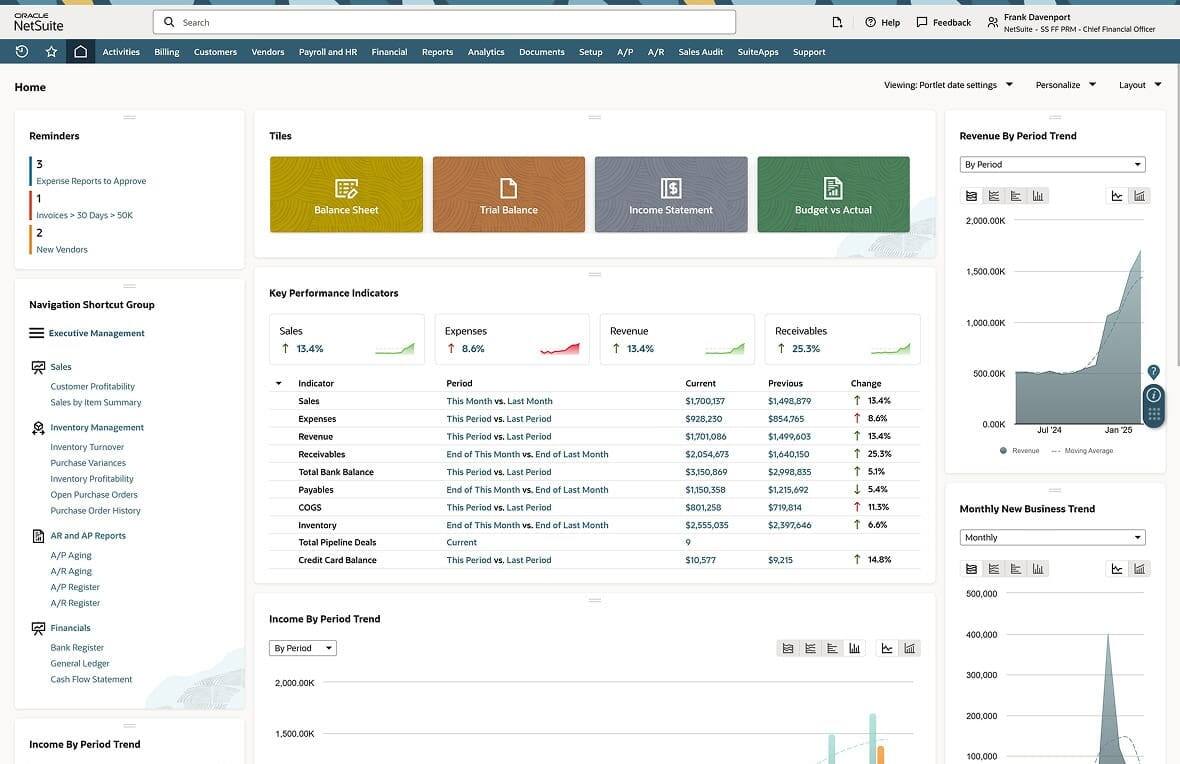
Tech startups need a clear view of their financial and operational performance so they can make informed decisions about where to invest limited resources and boost their chances of success. NetSuite Enterprise Resource Planning (ERP) System centralizes core financial and operational processes in a single, AI-powered cloud management platform that spots financial anomalies before they escalate, explains the factors driving key metrics in plain language, and forecasts cash needs from real-time data. Its SuiteSuccess customer lifecycle methodology draws on NetSuite’s 25-plus years of experience working with tens of thousands of companies to help startups go live quickly with preconfigured, industry-specific tools and add capabilities in phases as the business grows. Together, these capabilities can help startups gain greater control over their operations and adapt as their needs evolve.
NetSuite ERP
The pressures facing new businesses rarely arrive one at a time, and they tend to scale up as the company grows. The same founder who once handled every hiring decision personally eventually has to trust a team to make those calls, and the same pitch that once won over investors on vision alone now has to hold up against real margin data. Startups that adapt to changing conditions can manage these obstacles without losing sight of what the business needs to reach its next stage.
For startups that aren't quite ready for a full ERP suite, NetSuite's QuickStart delivers an AI-powered accounting platform packed with early-stage essentials. With free access and one-day configuration, QuickStart simplifies accounting for startups, addressing one of the key challenges to growth thanks to time-saving automation for record management, banking, payments, inventory, and more.
Tech Startup Challenges FAQs
How can startups overcome funding challenges effectively?
Startups can improve their chances of raising capital by validating demand early and showing a clear path to strong revenue before pitching to investors. To remain financially stable, they also need to carefully monitor their cash balance and runway.
How can a tech startup identify product-market fit?
Startups can pinpoint product-market fit by testing their products and services with customers. Strong customer retention, positive feedback, and growing demand are signs that a company has found the right product-market fit.
What is the biggest challenge of running a tech startup?
Startups face many challenges. Chief among them is managing limited resources while making key decisions about product development, customer acquisition, and growth execution.
What are the five pillars of a successful startup?
A successful startup needs strength in five key areas: product-market fit, financial management, customer acquisition, talent, and scalable operations.