
Most fintech decisions are made under pressure—approve or deny a transaction, escalate or clear an account, answer a customer’s request now or later, choose which new features to prioritize before a competitor owns the space. In the past, employees had to sift through spreadsheets and follow static rules before signing off on any of those decisions. Meanwhile, overworked teams could buckle under the pressure of savvier fraudsters, higher transaction volumes, faster competitors, and rising customer expectations.
AI changes what fintech teams can do a single moment. It draws on more data than a person could review alone to deliver detailed analyses or, in some cases, handle the task itself. But a rushed deployment creates real risk, so fintech companies should first understand what these tools can do, where they deliver the clearest advantages, where they can fall short, and how to best prepare for future advancements.
What Is AI in Fintech?
AI in fintech refers to the use of machine learning, predictive analytics, generative AI, and AI agents to automate aspects of financial operations and decision-making. Fintech companies typically deploy AI throughout the products and systems that customers and internal staff use every day to help complete tasks that once needed manual intervention, such as catching suspicious transactions in multiple ledgers or answering more nuanced customer questions than traditional automation could handle.
AI is gaining traction in a wide range of fintech verticals, including digital-only banks, payment processors, digital wallets, lending platforms, and wealth management apps. Within each vertical, companies often deploy AI for customer-facing features, such as support chatbots or personalized savings recommendations, as well as internal functions like compliance monitoring or account reconciliation. That breadth is why “AI in fintech” can mean something different from company to company. A founder building a lending product and a compliance officer at a payments company may use the same terms to describe different capabilities and initiatives.
Key Takeaways
- Fintech companies can deploy AI in nearly every department, but every use case requires clean and accessible data to produce real benefits and reliable outcomes.
- AI built into a business’s core strategy tends to work better than AI bolted on to existing processes, without deliberate planning.
- As AI automates more complex tasks, human oversight matters even more to preserve reliability and compliance.
- Open banking, AI agents, and embedded AI are setting the stage for AI’s future in fintech.
AI in Fintech Explained
Fintech and the banking industry have used rule-based automation for years to highlight transactions that exceeded certain dollar thresholds or were connected to unauthorized accounts. But when fraud or spending patterns shift—especially as more cybercriminals start adopting AI tools of their own—those approaches are either slow to adapt or they break down altogether. Machine learning replaced fixed rules with models that learn from historical data and adjust as new patterns emerge to fuel both automation and the predictive analytics finance teams rely on for forecasting.
In recent years, GenAI expanded what was possible with its ability to read requests and produce responses in everyday language. This allows companies to answer customer-support questions automatically, summarize loan files, generate detailed ad hoc reports with exact specifications, and tailor performance and forecast presentations to stakeholders of varying backgrounds and expertise. AI agents do more by combining large language models with domain-specific logic to run multistep workflows within set parameters and with minimal human intervention. Agents can help teams catch outlier transactions, pull relevant account histories, assess issues, and route cases to the right analysts with recommendations attached, all in seconds. Rule-based automation, GenAI, and AI agents work together to both query and feed a centralized database that keeps the whole operation running.
How AI Is Reshaping the Fintech Industry
Fintech companies are ahead of traditional banks and insurers when it comes to AI. In fact, 47% of fintechs report advanced AI use, compared to only 30% of incumbent financial institutions, according to Cambridge’s “2026 Global AI in Financial Services Report.” And that higher adoption rate has translated to real gains, with 56% of fintechs reporting greater profitability thanks to AI, as opposed to 34% of traditional financial institutions.
Part of that edge stems from fintechs being smaller and newer and not needing to retrofit AI onto systems built for something else, as is often the case for traditional financial companies. A fintech startup doesn’t have decades of legacy infrastructure or ingrained manual workarounds standing between its data and its AI models. Still, adoption alone doesn’t guarantee results. Across the financial services industry, most firms are using AI somewhere—81%, according to Cambridge—yet only 14% consider it “transformational to their organizational strategy and competitive advantage.” That execution gap reflects a broader trend: The companies pulling ahead are the ones purposefully incorporating fintech automation and AI into how the business runs, not just adding a chatbot to an existing app.
6 Advantages of AI in Fintech
Deploying AI everywhere at once can lead to untested applications that leave staff overwhelmed and create more problems than they solve. A phased rollout lets companies test AI features in a controlled environment and measure where the features bring benefits and where they need adjustment. For example, if a fintech company launches an AI tool to accelerate fraud triage, the implementation team can measure its impact and then extend the same approach to compliance and customer service. No matter which department a company starts with, it should look to the following six areas for quantifiable benefits that can compound as usage increases:
- Accuracy: Manual data entry, rule-based checks, rigid scripts, and human review can all miss details. AI models trained on large transaction histories notice subtle patterns spread throughout multiple accounts or departments, which can subsequently cut down on both false approvals and false alarms.
- Operational productivity: Tasks that took a team days, such as reconciling accounts or processing invoices, can run in minutes once AI handles the first pass. Staff can instead spend their time on exceptions that require a more deliberate approach and leave the mundane to finance automation tools.
- Business insights: GenAI can turn a spreadsheet of transactions or raw data into a business intelligence report written in plain language that explains current trends and what’s driving them. Managers and executives can gain an understanding of why revenue moved before consulting with a human data analyst.
- Risk management: Models that continuously score fraud and regulatory risk spot problems closer to the moment they happen. Teams that notice issues early, instead of having to wait for the next quarterly review, can close gaps before they spread to other departments or show up in compliance reports.
- Customer experience: For routine questions, AI-powered support can understand customer queries better than phone trees or traditional chatbots. When a human is necessary, AI chatbots can route the issue to a representative with full context and suggested resolutions, so customers get faster answers without repeating their information multiple times.
- Scalability and accessibility: AI-driven automation allows a fraud model to score 100,000 transactions the same way it scores 100. That scalability allows smaller fintechs to service just as many customers as their larger competitors without the need for an equally large team of experts.
12 Applications of AI In Fintech
Most fintech firms focus their AI adoption on their biggest pain points, whether that’s fraud detection, customer support, back-office operations, security, or supporting internal development. Once they start to see measurable results, they can replicate successes throughout their operation. These 12 applications cover the major areas where AI helps, starting with the most widely deployed use cases first.
-
Fraud Detection and Account-Takeover Prevention
Fraud detection was an early area for machine learning, and it remains one of the most prevalent use cases. AI models compare transactions to a customer’s typical behavior in real time and highlight combinations of signals that may not seem suspicious on their own, such as a login from a new device followed by a larger-than-usual transfer. Newer tools may even add behavioral biometrics, such as how a user types or scrolls, to catch account takeovers despite the attacker having valid login credentials. As fraud gets harder to spot, a layered approach matters more. In fact, 88% of the 1,440 fraud, financial crime, risk, and compliance professionals surveyed by BioCatch in June 2026 say AI has already increased the sophistication of threat actors with 80% saying their organizations have already faced attacks carried out by AI agents.
-
KYC/AML Automation
Know Your Customer and anti-money laundering checks have customarily relied on manual document reviews and long onboarding queues. AI-based document verification can confirm an applicant’s identity in seconds, while machine learning models can cross-reference transactions against sanctions lists to look for patterns tied to money laundering. False positives can drown compliance teams in alerts that turn out to be nothing, so AI models trained on historical case outcomes can help teams triage those alerts and focus their time on the ones that matter.
-
Customer Support Automation
AI-powered support built directly into a fintech’s CRM system can handle account questions and basic troubleshooting without sending customers to long queues with even longer wait times. Under the hood, GenAI allows these tools to respond in natural language that adapts to the customer, instead of relying on rigid decision trees that break down when queries veer away from established rules. The better implementations know their limits by following preset parameters that allow them to distinguish between routine questions they can resolve immediately and sensitive topics that need to go to a person, such as a customer’s financial hardship or transaction dispute.
-
Back-Office Finance Operations
Back-office finance tasks, such as reconciliation, accounts payable, invoice processing, and month-end close, have historically eaten up finance teams’ time. For fintechs moving high volumes of transactions among multiple payment systems and bank partners, the reconciliation burden is especially heavy. At scale, AI tools can now match transactions across bank feeds and payment systems automatically. That data can then feed GenAI tools embedded in an ERP system, turning an accountant’s shorthand notes into a clear record tied to current account information that the next person can reference. The result is a faster close and fewer hours spent chasing down mismatched entries.
-
Underwriting and Collections Optimization
Traditional underwriting can rely heavily on credit bureau data, which may be limited for applicants without long credit histories. AI models can incorporate and consider a wider range of data, such as cash flow patterns from a business bank account, to better develop an applicant’s risk profile. On the collections side, models can monitor late-payment and delinquency trends, then recommend follow-up timing and contact channels before missed payments slip through the cracks.
-
Customer Retention and Churn Prevention
The signs of a customer getting ready to switch to a competitor can show up long before they actually leave. Signals might include fewer logins, smaller balances, slower response to offers, or fewer transactions. AI models trained on that behavior can identify at-risk accounts inside a fintech’s CRM early enough for a retention team to check in proactively or make a personalized offer before it’s too late. The more data the AI can access, the more specific its reasoning can be—after all, a generic alert that a customer might churn really isn’t enough information for the retention team to act on.
-
Cash Flow Forecasting
AI models incorporate vast amounts of data, including seasonality, customer payment behavior, billing cycles, and market data to produce rolling forecasts that adjust as new data comes in. For fintechs offering treasury or lending products, more accurate forecasting means more appropriate contract and loan terms befitting the current market—and fewer surprises for the businesses they serve. For example, a treasury platform’s AI-driven financial forecasts can incorporate rising vendor prices and payment deadlines to warn a small business that its cash position is dropping below a safe threshold before its quarterly tax payment comes due. This early warning gives the business owner enough time to draw on a credit line before the company account runs dry.
-
Regulatory Compliance Automation
Financial regulations change frequently, and fintechs operating in multiple states or countries must keep tabs on the shifting compliance requirements in every jurisdiction. AI tools can scan new regulatory text and news sources, map upcoming changes against existing internal policies, generate detailed explainers, and suggest changes to protocols that meet new requirements—all without the manual research that compliance teams once did, line by line. The same tools can then help automate the reporting itself by pulling data from multiple systems into the type of format regulators require throughout the financial period, instead of teams needing to assemble reports by hand at the end of each quarter.
-
Cybersecurity and Threat Defense
Fintech firms are a frequent target of cyberattacks, and many perpetrators now use AI to create more convincing phishing attempts and to automatically probe systems for weaknesses. To stay ahead of cybercriminals, fintechs can deploy AI-driven monitoring tools to analyze network activity around the clock for any signs of an attempted intrusion. The less time between the start of an attack and security getting involved, the better the chance a company has to reduce exposure and mitigate the damage. And proactive security efforts are actually becoming mandatory. The EU Digital Operational Resilience Act requires covered financial entities to manage Information and Communication Technology risk, including third-party ICT risk, and the US Gramm-Leach-Bliley Act requires covered financial institutions to explain certain information-sharing practices and safeguard customer information.
-
Data Infrastructure Modernization
Many fintechs still run on a patchwork of systems that can’t easily communicate with each other, which means a fraud model sees a different picture of the customer than the underwriting model, and neither can learn from the other’s business intelligence. An under-the-hood digital transformation, often achieved by consolidating scattered systems into a financial services ERP platform, can be the difference between an AI implementation that earns its keep and one that stalls in a pilot program.
-
Governance and Explainability
An AI model that can’t justify its decisions creates risk in financial services. This is particularly important in credit and lending decisions. For example, in the U.S., ECOA and Regulation B require creditors to provide specific reasons for adverse actions. Explainable AI techniques let a fintech show which factors guided any scores or recommendations, which helps firms satisfy regulators and make necessary adjustments to models when they start to drift. Regulators increasingly expect this as a default. Under the EU AI Act, for example, evaluating creditworthiness is a high-risk use case and requires “regular systematic review and updating” and human oversight.
-
Productivity and Talent Development
AI is changing how fintech employees spend their time. Developers use AI coding assistants to speed up routine updates and bug fixes, compliance staff rely on AI to prescreen alerts, finance teams use it to draft the first pass of a report, and analysts use it to pore through large data sets in less time than they could handle manually. This shift can reshape roles rather than simply eliminate them. Cambridge found that 25% of financial services firms expect “significant reskilling and job transformation without large net losses.” AI can help meet that goal by accelerating onboarding and cross-training through targeted skill development that builds a more flexible, adaptable workforce.
AI Considerations for Fintech Businesses
For fintechs, one of the biggest hurdles to adopting AI is data governance and quality. Indeed, 34% of fintechs surveyed by Cambridge cite data availability and quality as their leading pain point. For example, a fraud model trained on incomplete or siloed transaction data is more likely to err in judgement than one trained on a complete picture, even if the underlying algorithm of the former is more sophisticated. Data drift is another concern. A model trained on last year’s transaction patterns can lose accuracy as spending habits, business objectives, fraud tactics, and market conditions evolve, and fintechs need to regularly test and retrain models to keep pace. Explainability in support of every decision is a growing compliance need, as regulators increasingly ask for proof that a model’s outputs can be traced back to specific, defensible factors.
When AI moves from scoring to acting, human oversight becomes even more important. An AI analysis tool can highlight suspicious transactions, but an AI agent that’s permitted to freeze an account needs much tighter guardrails. Successful agents tend to start with narrow, low-stakes tasks, with fintechs expanding the agent’s authority only as results build trust and teams add rules on how the system should handle exceptions.
Trends and Emerging Innovations in Fintech AI
AI’s capabilities are expanding quickly, and deciding when and where to prioritize investments can be challenging. Building strong AI infrastructure now can pay off regardless of which trend wins out, since new models and deployment methods will still need the same clean, connected data. The three trends below show where AI investment is taking off:
- Open banking: Open banking started with sharing account data through secure APIs before expanding into a broader “open finance” model that includes savings, investment, lending, and insurance data. AI puts that expanded data to work to offer more personalized lending offers, account suggestions, budgeting tools, and risk assessments than a fintech could build with transaction data alone.
- Agentic AI: Fintech companies are giving AI agents permission to handle an increasing list of multistep tasks in both back-office and customer-facing functions. They’re also gaining infrastructure to build upon as established payment networks roll out agent frameworks, such as Mastercard’s Agent Pay and Visa’s Trusted Agent Protocol, which, among other things, give fintechs standardized, secure rails for letting AI agents transact and verify identity at checkout. These programs will likely mature and expand as agent-to-agent transactions become more commonplace.
- Embedded AI: Much of today’s fintech AI is invisible and built into the products employees and customers already use. For instance, AI-powered fraud scoring might be running silently behind every transaction, while an AI agent automatically refreshes forecasts as new data comes in. These “hidden” applications often speed up adoption because users don’t need to learn a whole new interface to realize the benefits.
NetSuite Accelerates Your AI Transformation
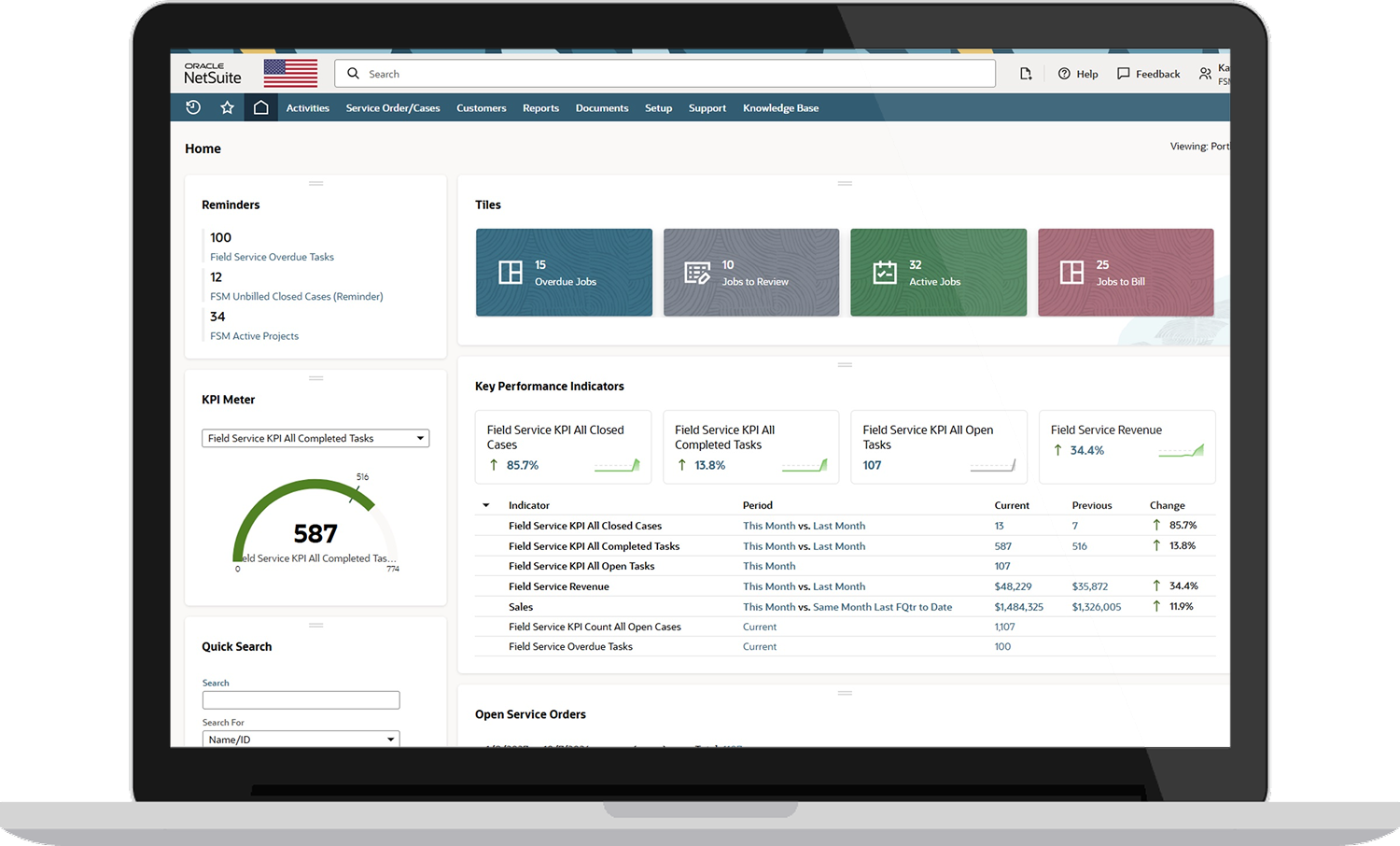
An AI application connected to scattered systems and inconsistent data can struggle to deliver meaningful value. NetSuite ERP Software for Financial Services unifies financials and customer data in a single cloud platform, so AI features like anomaly detection and narrative reporting work from the same up-to-date numbers that the rest of the company relies on. Embedded AI analytics helps teams generate plain-language explanations for supported reports and identify unusual transaction patterns. For eligible users, Ask Oracle lets teams query company data conversationally and request tables, charts, or summaries in natural language. And NetSuite is scalable, so growing fintech businesses can add modules for billing, revenue recognition, cash management, or multi-entity management as needed, each pulling from and adding to the shared data foundation that powers NetSuite’s AI.
NetSuite’s Business Intelligence Dashboard
AI in fintech is a full set of capabilities ranging from straightforward fraud monitoring to sophisticated AI agents that tackle multistep workflows. But AI implementation is an ongoing project that requires regular data cleaning and fine-tuning to stay reliable. The fintechs best positioned to evolve with this technology are the ones that focus on a deliberate rollout and a strong technology foundation— rather than deploying the newest models and moving on to the next trend.
AI in Fintech FAQs
How can AI be used in fintech?
Fintechs use AI throughout their operations, such as for fraud detection, risk assessment, customer support, compliance, and back-office financials. The technology includes machine learning models for real-time analytics and AI agents that automate multistep tasks like routing transactions and updating ledgers.
What AI solutions are most used in fintech?
Fraud detection and Know Your Customer/anti-money laundering automation are common AI applications in fintech. Customer support automation and risk assessment are also widely used, with AI agents now emerging for more complex use cases, such as cash flow forecasting and compliance reporting.