
Financial institutions have spent years using technology to automate individual tasks, from highlighting suspicious transactions to answering common customer questions, but the next wave of AI is aimed at tackling the complex, multistep processes that consume millions of hours of employee time every year. In the document-heavy, rule-intensive financial services industry, agentic AI promises to rewrite the productivity equation. Employees get time back, processes speed up, and firms can manage more work without adding head count. This article offers a comprehensive look at the benefits of AI agents in financial services, as well as three best practices for strategically putting it to work.
What Is Agentic AI in Financial Services?
Agentic AI in financial services is a form of AI that can autonomously plan and take actions to complete multistep financial workflows involving multiple systems with limited human intervention. It can execute the steps needed to achieve a defined goal, use approved tools and data sources, evaluate what it finds, and adapt its next action based on the results, adhering to rules a company sets beforehand.
In financial services, an AI agent could investigate a suspicious transaction by pulling relevant account records, reviewing the customer’s profile, checking external data sources, and comparing the activity with known fraud and money-laundering patterns. It could then summarize the results and recommend potential next steps for a fraud analyst, such as escalating the alert or clearing the transaction.
Key Takeaways
- McKinsey estimates AI could reduce banks’ aggregate cost base by 15% to 20% while kickstarting new productivity gains.
- AI agents can hasten customer onboarding by handling document collection and background checks and can improve retention by identifying dissatisfied customers for personal outreach.
- By connecting legacy banking, payments, accounting, risk, and CRM systems, AI agents can serve as an orchestration layer that coordinates the steps that keep processes moving.
- Best practices for reaping the benefits of AI agents include training employees and setting clear boundaries for what agents can and can’t do, then measuring results to confirm the approach is working.
Agentic AI in Financial Services Explained
Just five years ago, financial institutions were dipping a tentative toe in the AI waters, experimenting with the technology to complete narrow tasks, such as pinpointing fraud or answering basic customer questions. Today, many financial services firms are stretching beyond traditional AI, which takes on discrete tasks, to make use of AI agents that can autonomously carry out multistep workflows. About 52% of firms surveyed in the Cambridge Centre for Alternative Finance’s “2026 Global AI in Financial Services Report” said they were actively adopting AI agents, with 23% scaling their use and another 29% running pilots.
Adoption is moving at different speeds across the industry. Many reported agentic AI use cases are clustered in workflow-specific operational functions, including credit, anti-money-laundering, and treasury work. A 2026 Charles Schwab study found 63% of wealth advisors already use AI, mostly for note-taking and client communications. Customer service leads the processes banks identify for deploying cloud-native AI agents at scale; 75% of banks cited it in a Capgemini survey.
Agentic AI vs. Generative AI vs. Traditional AI
Traditional AI in financial services is generally designed to analyze information and make predictions—say, identifying a potentially fraudulent payment or forecasting market risks. GenAI can create new content in response to a prompt, for example, by summarizing a customer’s financial history or drafting a loan recommendation.
Meanwhile, agents broaden the AI role from providing an answer to pursuing a goal by completing an entire workflow for a particular process. An agent is trained on an objective. From there, it can determine the steps required to accomplish it; access different systems and tools, such as account platforms or compliance databases; evaluate the information it gathers; and then act on the results. It can request missing information or escalate exceptions for human review.
What Is Driving Agentic AI Adoption in the Financial Services Sector?
It’s easy to see why AI agents are gaining momentum in financial services. The industry faces persistent pressure to improve productivity and control costs, despite managing complex operations and grappling with ever-increasing compliance requirements. Agents can ease pressure by taking on more of the time-consuming, costly work embedded in routine financial processes, such as reconciling accounts or verifying documents. Newer agents can work independently for hours or more at a stretch, long enough to review overnight market activity and client positions. That makes autonomous, multistep work practical in a way it wasn’t even a year ago. McKinsey & Company expects AI could reduce banks’ aggregate cost base by 15% to 20%, while noting that the timing of that disruption is uncertain.
KPMG says agents’ ability to automate complex tasks is doubling every three to seven months. Separately, based on its analysis of more than 17 million companies, KPMG estimates agentic AI could unlock $3 trillion in annual corporate productivity improvements.
4 Key Benefits of Agentic AI in Financial Services
Employees have traditionally handled complex financial services processes by collecting data from multiple systems, such as transaction and payment systems, applying rules, documenting decisions, and moving information from one stage to the next. That’s exactly the kind of work agents can coordinate and execute. Financial services firms can get the following four benefits from AI agents:
- Increases efficiency and productivity: With AI agents, internal processes move faster from start to finish. Fighting financial crime is a particularly promising area for agents, because investigations typically require pulling and cross-checking information from transaction and case management systems, exactly the kind of high-volume, well-defined work agents handle best. McKinsey estimates that one human could supervise 20 or more AI agents, potentially delivering productivity gains of 200% to 2,000%.
- Enhances decision-making: Though agents certainly won’t make every decision, they can help financial professionals make better decisions by identifying which opportunities deserve their attention. Rather than asking bankers to wade through large customer portfolios to search for sales opportunities, for example, agents can research the most promising prospects and prepare the necessary information for those conversations.
- Lowers administrative burden: Handling administrative tasks may be one of the least exciting use cases for AI agents, but it happens to be one of the most consequential. Agents can manage an entire process, as opposed to helping an employee complete one task faster. Without the burden of manual tasks, employees can focus on strategic initiatives that require greater expertise, as well as pursue more meaningful interactions with customers and colleagues.
- Improves customer experience: Customers lose patience if they must speak with several departments to resolve a relatively simple problem. An agent can review transactions, check account histories, collect information to investigate it, and prepare a dispute on behalf of the customer. It can then track the claim through resolution and escalate to a human when the case falls outside the agent’s authority. Agents can resolve issues faster and spare customers from making multiple calls.
Agentic AI Use Cases in Financial Services
The most promising applications of AI agents entail high-volume, repetitive work involving multiple systems. Here’s a look at 10 common agent use cases in financial services.
Financial Crime Compliance
Financial institutions are subject to extensive requirements for preventing and detecting financial crime, including money laundering and terrorist financing. They must regularly assess and investigate suspicious activity, then report violations to regulators and law enforcement agencies. Agents could help automate much of that work. An agent can gather information from transaction monitoring, case management, and sanctions screening systems, then check it against regulatory requirements and compile the evidence to either clear or escalate alerts. Agents can also assemble the necessary documentation for regulatory reporting and audits.
Customer Onboarding and Retention
Opening an account has traditionally required both customers and employees to move through several time-consuming steps. KPMG estimates that agentic automation in wealth management could accelerate client onboarding time by 50%. And for firms currently limited by how fast they can process new applicants, that freed-up capacity could translate into significantly more customer acquisitions. KPMG puts the potential upside as high as doubling annual client acquisitions. An AI agent could ease the onboarding process by collecting and validating documents, conducting AML and KYC checks, verifying employment details, and updating account and compliance records, all while communicating with the customer. Agents could also help retain customers by monitoring their behavior and launching personalized outreach when signs of dissatisfaction emerge.
Fraud Detection
Despite years of rising investment in fraud detection, financial services firms still struggle to identify illicit activity, partly because the work is labor-intensive and involves synthesizing information from many sources. Agents could take on much of that burden. A fraud detection model can identify an unusual payment, and an agent could automatically examine the customer’s transaction history. It could then compare the activity to known fraud patterns, assemble the evidence, and route higher-risk cases to human investigators, including an explanation of why the activity appears suspicious or why it’s legitimate. It could also take predefined protective actions, such as temporarily restricting an account or requesting additional verification. Automating this investigative work could reduce false positives. It can also give human analysts time to focus on the cases most likely to represent legitimate fraud.
Underwriting and Lending
Lending is one of the higher-value applications for agents because underwriting directly influences both revenue generation and risk management. Faster processing can help financial institutions make quicker lending decisions to improve the borrower experience, while better analysis and ongoing monitoring can help them manage credit risk. Agents can collect financial statements, tax documents, bank account information, and credit data. They can then analyze the borrower’s financial position, compare the application against lending policies, prepare an underwriting memo, and send the application for human review and approval. In commercial lending, agents can extend the approach beyond origination by monitoring borrowers, identifying changes in financial stability, and highlighting potential credit risks for a person to review.
Customer Service and Multichannel Resolution
A customer might reach out to a financial institution to dispute a charge or investigate a payment. An agent can determine the necessary next steps, retrieve account information, execute approved actions, and follow up with the customer. The agent can maintain context as a customer hops from mobile app to online chat to a branch visit to phone. The customer doesn’t have to start over with each interaction. A multichannel resolution system owns the customer’s problem from beginning to end. Having AI in the mix results in a faster customer experience, where problems are resolved with fewer handoffs. That means less customer frustration and lower service costs.
Treasury, Cash Management, and Financial Close Operations
Treasury and finance teams spend a lot of time moving among core, ERP, and reconciliation systems to dig up data and investigate discrepancies. That takes time away from the daily work of managing cash flow, reconciling transactions, forecasting liquidity, and completing the financial close. AI agents pull these processes together by continuously monitoring financial activity, identifying issues for finance teams as they emerge, and taking approved actions without requiring humans to connect each step. Staff can then spend more time on analysis and other higher-value decisions.
RegTech Automation
Financial regulations are constantly changing, and the cost of getting compliance wrong can be steep, often involving regulatory fines and reputational damage. RegTech is technology for managing regulatory and compliance requirements. It helps financial institutions keep up, and AI agents can assist. An advanced system could use specialized agents to divide up the work. For example, one agent could monitor regulatory changes, another could map them to internal policies, and a third could verify that a company has updated its controls. Throughout the process, the agents maintain an audit trail to show evidence of compliance.
Back-Office Automation
One of the greatest opportunities to slash expenses lies in financial services’ back-office operations, much of which involves routine high-volume processes. Typically, employees have had to move information through payment and account systems and coordinate next steps. Here’s how AI agents might handle a payment exception: The agent learns why a payment failed, checks relevant account data, ascertains whether it can be resolved automatically, takes the permitted action, and bumps the case to an employee, if necessary.
Wealth Management
Wealth management firms can use agents to relieve advisors of administrative headaches and give them time to work on client acquisition and retention. For example, an agent could prepare for a client meeting by amassing the latest account information and portfolio activity, summarizing what’s changed since the last conversation, and drafting an agenda. After the meeting, the agent could produce a recap, update the client record, prepare follow-up communications, schedule tasks for completion, and track the client’s outstanding requests. That means fewer hours spent on meeting-related busywork, and more time for advisors to serve more clients.
Legacy Technology Orchestration
Financial institutions often have critical processes spread among decades-old core, payments, accounting, risk, and customer systems that don’t integrate smoothly. AI agents can bring that fragmented technology together, coordinating workflows among multiple systems, but only if an orchestration layer tracks each step. Otherwise, an AI agent working through dozens of steps can leave a transaction partly finished if one of those systems fails partway through. So, when a business customer applies to open a commercial account, an agent can manage the workflow through CRM, KYC, credit, and core systems, initiating required steps, tracking completed work, and escalating approvals.
3 Agentic AI Best Practices for the Financial Services Sector
To get the most out of AI agents, financial services firms must set the stage by redesigning how teams work and make decisions. Follow these best practices to capture the most value from agents:
- Prioritize training and change management: Employees using agents will see their responsibilities shift from completing every process themselves to supervising and intervening at key points as agents complete automated work. Train teams to oversee agent output, so they know when to rely on an agent, when to challenge its recommendations, and when to step in with human judgment. Redesign workflows and clarify decision rights so employees understand how their roles will change.
- Establish clear governance policies: Set explicit limits on what agents can access and execute as opposed to which activities are off-limits and require human review. For example, a governance policy might dictate that an agent can gather income, employment, and credit history information for a credit application, but a qualified employee must review the completed file and make the final decision. Financial institutions currently have to build these policies largely on their own. April 2026 US federal interagency model risk guidance excludes generative and agentic AI models from its scope, while noting that existing risk-management and governance practices should guide controls for systems not covered.
- Benchmark improvement against performance KPIs: Before implementation, establish a baseline for each targeted process, and track financial KPIs and other performance measures, such as cycle time, error rates, costs, and customer outcomes. Just as important, measure any trade-offs. If an agent accelerates a process but compromises the review quality, the firm might need to tweak the process. Track how much staff time an agent’s outputs require, not just how many tasks it completes. That’s frequently the more telling measure of whether an agent is paying off.
Lay the Foundation for AI-Driven Finance With NetSuite ERP
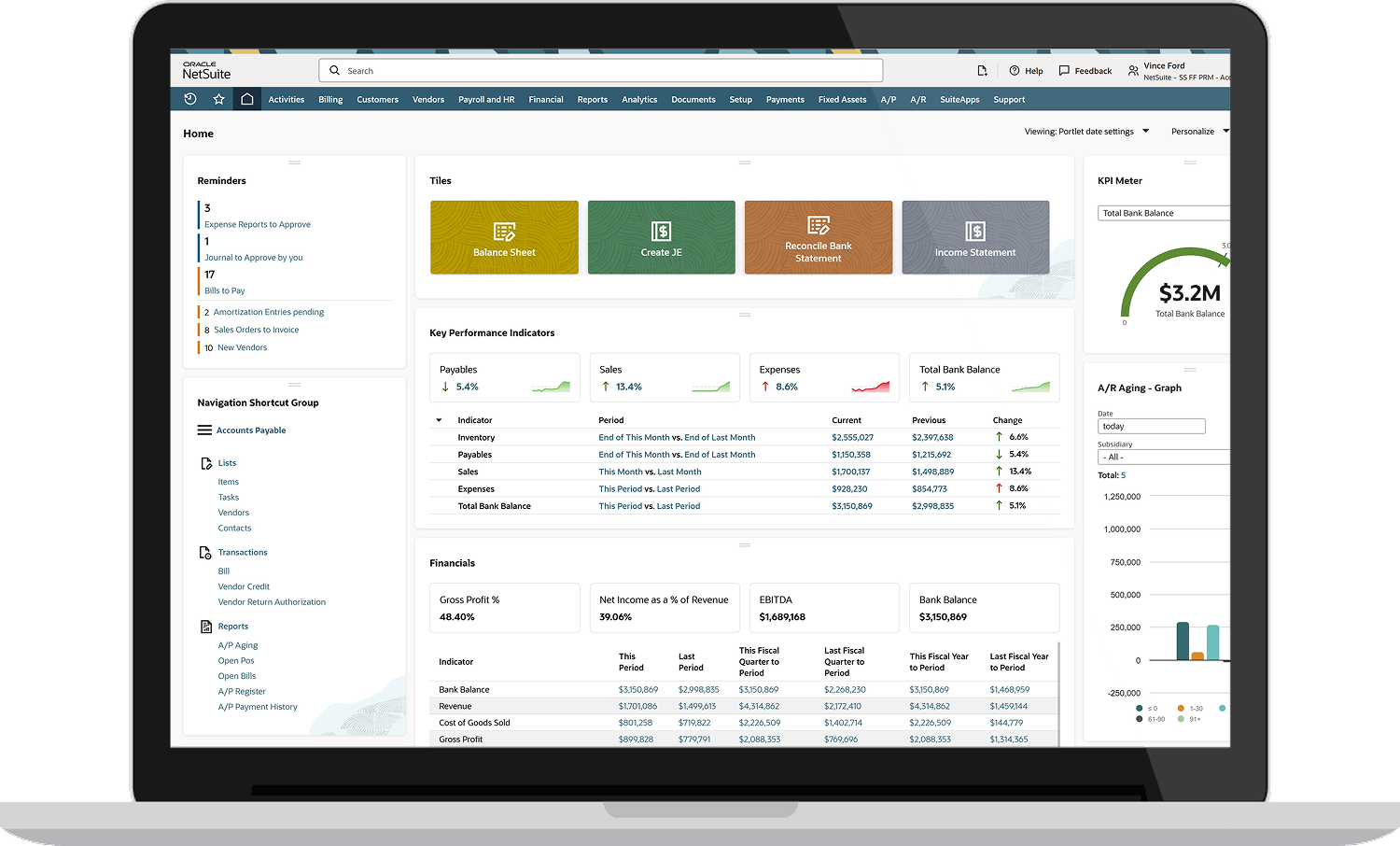
The processes that protect financial services businesses—reviews, approvals, reconciliations, and compliance checks—can also consume enormous amounts of time. AI agents offer a way to automate more of the steps involved, but they need a reliable view of the business and clear rules for what they can and can’t do. NetSuite ERP Software for Financial Services combines accounting, financial management, CRM, data governance, and other business functions in a single platform. It automates core processes, including reconciliations and reporting, while embedding approval workflows, role-based access, and audit trails. That gives a financial services firm a more structured foundation on which to base its evaluations when it comes to integrating AI agents into controlled financial processes.
AI agents have the potential to take a lot of time-consuming work off the hands of financial services teams. Agents can help financial institutions get more work done faster, but only if firms first evaluate which processes agents can handle reliably and put sensible limits in place. Giving employees a clear role in overseeing the technology matters just as much, because employees have more time to help customers and make decisions that require human judgment.
Agentic AI in Financial Services FAQs
How is agentic AI different from robotic process automation (RPA)?
Robotic process automation (RPA) follows predefined rules to automate specific repetitive tasks, while agentic AI can plan and execute the steps needed to achieve a goal. For example, an RPA bot might transfer customer information from an onboarding form into the bank’s system, while an AI agent could manage the broader onboarding process, including checking documents, identifying missing information, initiating required checks, and routing the application for review.
What technologies enable agentic AI?
Agentic AI combines several technologies to deliver the ability to plan, analyze, access information, and take action. Large language models provide the reasoning and planning capabilities, while tool-calling and APIs allow agents to interact with core financial and CRM systems and execute approved actions. Retrieval-augmented generation can give agents access to internal documents and company data, and agent orchestration frameworks coordinate complex tasks and interactions between systems.
How can financial services get started with agentic AI?
Introducing agentic AI in financial services starts with identifying a process that’s time-consuming and governed by clear rules, such as customer onboarding or reconciliation. Define what an agent can do, where human approval is required, and how to measure success. A focused pilot can help prove the value of AI agents before expanding the technology to include more processes.