
A tech founder in 2019 could secure a large funding round and a massive valuation simply by demonstrating exponential user growth. Investors treated a fast-rising user count as proof enough that profits would follow and rarely scrutinized whether the startup had made money on each user. But by 2022, as interest rates rose and capital markets tightened, investors stopped taking growth on faith and began asking for direct evidence of profitability.
This article explains what profitability looks like at each stage of a tech startup’s life and how to improve it without stalling growth.
What Is Tech Startup Profitability?
Tech startup profitability refers to an early-stage, high-growth technology company’s ability to generate more money than it spends. Its interpretation varies depending on the company’s stage. For example, a seed-stage startup might be counted as profitable if it earns more from each customer than it costs to serve them, whereas a company approaching an IPO is held to a stricter standard of demonstrating profitability throughout the entire business.
Key Takeaways
- Different profitability metrics can tell different stories about the same startup, and no single number gives the full picture.
- Decisions about when to focus on growth and when on profitability depend on a startup’s stage, market conditions, and cash position.
- Disciplined choices about pricing, hiring, and resource allocation can help improve profitability.
Take a Free NetSuite Product Tour

What Does Profitability Look Like for a Tech Startup?
A tech startup can be profitable in one area of the business yet be losing money overall. Before the word “profitable” means anything, founders need to know exactly what they’re talking about. The first layer of profitability is unit economics: Does the company make more money from customers than the amount it costs to serve them? A startup can clear this bar and still lose money overall because unit economics doesn’t account for costs associated with product development and customer acquisition.
Gross margin comes next. Does revenue cover the direct cost of delivering the product—hosting, infrastructure, and support for a software company, or materials and manufacturing for a hardware startup? Gross margin determines how much money is left to fund everything else. Contribution margin goes further, contributing the cost of acquiring each customer, mainly sales and marketing spend. A company can look healthy on gross margin but negative on contribution margin if it’s spending aggressively to grab market share, often a deliberate choice early on.
Operating profit is what most people mean when they ask if a startup is making money. A company reaches this level once its revenue exceeds every cost of running the business, including product development, sales and marketing, and administrative overhead. Investors often look at operating profit alongside EBITDA, a related figure that leaves out certain accounting-only costs like depreciation and amortization, so it usually comes out a bit rosier. That gap is small for asset-light software startups but real for hardware or deep-tech companies that own costly physical equipment whose value declines year after year. Beyond operating profit lie stricter tests, such as net income and free cash flow, which founders and investors lean on most when raising a funding round or approaching an IPO.
What Investors Look for in a Profitable Tech Startup
Investors still look for the fundamentals that have always mattered in venture capital: a large addressable market, a strong team, clear traction, and some form of competitive differentiation. What has changed is that total registered users, gross merchandise value, and other vanity metrics that once justified sky-high valuations now matter less than indicators of financial discipline, such as gross margin and cash runway. Investors increasingly use two calculations to measure that discipline directly:
- The Rule of 40 adds a company’s revenue growth rate to its profit margin, and a combined score of 40 or higher signals a healthy company. Whether that score comes from a high growth rate, a strong margin, or some mix of both, it signals that a startup is earning its growth instead of just buying it with cash.
- The burn multiple divides net cash spent by the new recurring revenue a company generates in the same period, showing exactly how much money it costs to produce one new dollar of revenue.
Take a Free NetSuite Product Tour
Growth vs. Profitability: Which Should Matter More for Tech Startups?
Depending on a company’s stage, market, and cash position, there are some instances when growth matters more and others when profitability is the priority. In the earliest stages, from seed through Series A, a startup can chase growth aggressively as long as it keeps its underlying unit economics sound and its customer acquisition cost (CAC) payback period manageable. By the middle stages, a startup’s growth should be efficient enough to create optionality—that is, the ability to choose growth or profitability according to what capital markets and competitive conditions demand at any given moment. At the late stage run-up to an IPO, investor and public-market tolerance for sustained losses narrows considerably, so companies are expected to keep growing while also becoming meaningfully more profitable.
Capital market conditions determine whether investors reward growth or profitability. When capital is cheap and abundant, they favor growth; when it’s scarce and expensive, they look for efficiency and margin improvement instead. In fact, a SaaS Capital survey found that equity-backed companies improved median profitability from –20% in 2023 to –7% in 2025, as investors demanded more discipline. This also plays out in valuations. Investors will price a fast-growing, unprofitable company on a multiple of its revenue, but once growth slows, the same company will get priced on a multiple of its profit. Startups that haven’t improved their margins by the time that transition arrives often take a real hit.
Why Some Tech Startups Prioritize Growth Over Profit
The clearest reason to choose growth over near-term profit is the network effect, where a product gets more desirable as more people use it. In markets where that matters, being early and large is more important than immediate profitability—that’s because a company that slows down to protect its margin can lose its competitive position and never get it back. The same logic applies in a milder form to markets with high switching costs, where locking in customers early builds an advantage that compounds over time. Still, prioritizing growth only works when it’s deliberate and backed by a real structural advantage. Too many startups default to growth-over-profit mode because raising money feels easier than building a profitable business. Then, they end up taking a down round or failing to raise at all, once capital tightens.
Take a Free NetSuite Product Tour
How to Calculate Profitability for Your Tech Startup
Every profitability metric starts from the same revenue and subtracts a different set of costs. Working down from one to the next shows why a single company can look profitable at one level and unprofitable at the next. Consider a startup with $2 million in monthly recurring revenue (MRR). Gross profit subtracts the direct cost of delivering the service—here, $460,000 in hosting, infrastructure, and support—and gross margin expresses that as a percentage of revenue:
Gross profit = $2,000,000 − $460,000 = $1,540,000
Gross margin = ($1,540,000 ÷ $2,000,000) x 100 = 77%
Contribution margin then subtracts the $700,000 spent on sales and marketing to win customers:
Contribution margin = $1,540,000 − $700,000 = $840,000
Contribution margin ratio = ($840,000 ÷ $2,000,000) x 100 = 42%
Operating profit subtracts the remaining costs of running the business—$900,000 in research and development and general and administrative expenses:
Operating profit = $840,000 − $900,000 = −$60,000
Operating margin = (−$60,000 ÷ $2,000,000) x 100 = −3%
Finally, net income subtracts everything else, including $180,000 in stock-based compensation to pay employees and other non-operating costs:
Net income = −$60,000 − $180,000 = −$240,000
Net margin = (−$240,000 ÷ $2,000,000) x 100 = −12%
The same company shows a healthy 77% gross margin and a −12% net margin. That’s why no single number settles whether a tech startup is profitable—it depends entirely on which costs you’ve counted and what investors want to see.
Take a Free NetSuite Product Tour
Key Tech Startup Profitability Metrics
The above metrics interact constantly with other key metrics, and a strong number in one area can hide a weakness somewhere else. The following six metrics come up more than any others in serious conversations about startup profitability. Together, they help founders answer important questions about how fast the company is growing, how much it’s spending to get there, and how much each customer is worth.
Growth Rate
Growth rate measures the month-over-month or year-over-year change in revenue, which subscription businesses most often track as MRR or annual recurring revenue. Growth rate is the input side of nearly every other profitability metric, including the Rule of 40 and the burn multiple, both of which depend on how fast the top line is moving. Growth naturally decelerates with scale, because doubling a large revenue base is a bigger lift than doubling a smaller one.
Cash Burn
Cash burn is the rate at which a company spends money, usually tracked monthly. Gross burn measures total cash going out, while net burn subtracts incoming revenue to reveal a more useful number, which is how many months of runway remain at the current spending rate.
Customer Lifetime Value
Customer lifetime value (CLV) estimates the total gross profit a company will earn from a customer over the course of the full relationship. It’s calculated by multiplying average revenue per account by gross margin, then dividing by the churn rate for the same period. More sophisticated versions of this calculation account for the time value of money and for customers that expand their spending over time, usually producing a more conservative estimate than the simple formula presents.
Customer Acquisition Cost
CLV becomes meaningful only after it’s weighed against the cost to acquire that customer in the first place. CAC calculates that number by dividing total sales and marketing expenses by the number of new customers gained in the same period. The two are usually compared as a ratio, with a CLV of at least three times CAC considered healthy. A related figure, the CAC payback period, measures how many months of gross profit from a customer it takes to recoup that acquisition cost. It’s often more useful than the raw dollar figure because it’s comparable across different product price points.
Break-Even Point
The CAC payback period is really the break-even point applied to a single customer—the moment that that customer’s margin has fully repaid what it cost to acquire them. Startups can also conduct a break-even analysis at the whole-company level by dividing fixed costs by the difference between price and variable cost per unit—which, in a SaaS context, typically means the monthly subscription price minus the direct cost to serve each customer, including hosting and support. The result shows how many customers, or how much MRR, the business needs before it turns an actual profit.
Gross Profit
As mentioned earlier, gross profit is revenue minus the direct cost of delivering a product or service, and gross margin expresses that figure as a percentage of revenue. Gross profit tends to climb as a startup matures and gains efficiencies, such as a SaaS company optimizing its hosting, support, and infrastructure services. Because gross margin sets the ceiling on how much money is left to cover the rest of the business, investors weigh it heavily when judging a company’s long-term potential.
Take a Free NetSuite Product Tour
6 Profitability Tips for Tech Startups
Improving profitability requires deliberate choices. A startup that hires reactively, prices by copying competitors, or funds every promising project without a filter ends up spending more than it should, without ever really choosing to. Founders who follow these tips can scale profitably instead:
- Understand your unit economics: Unit economics tells you whether a single customer makes or loses money after subtracting the cost to acquire and serve them. That number matters more as you grow, because scale multiplies it—a small loss per customer becomes a large one as the customer base expands. Tracking CAC, CLV, gross margin per customer, and payback period every month catches a negative trend early, before growth turns it into a crisis.
- Be intentional with your hiring strategy: Head count is usually a startup’s largest cost, and cutting that expense is far more disruptive than trimming in other areas. Hiring ahead of actual need quietly erodes runway and the burn multiple. Forecasting hiring needs against long-term milestones and reserving new roles for mission-critical work will more closely tie head count growth to revenue.
- Resist the temptation to underprice: Underpricing is one of the most expensive mistakes an early-stage startup can make, because prices are hard to raise once customers get used to a number. But it’s extremely common among founders who haven’t quantified the economic value their product delivers and instead price by gut feel or by copying competitors. Although free tiers can work for certain products, in most cases they attract low-intent users and teach the market to expect the product for nothing.
- Pinpoint your best-performing customers: Mapping every customer touchpoint, including the real cost of onboarding and ongoing support, usually shows that a small share of customers generates most of the profit. Focusing the product roadmap and sales targeting on that segment improves margins more than chasing raw customer count.
- Keep an eye on low-return projects: Engineering and product development resources are finite, so every project a team takes on comes at the cost of another it can’t pursue at the same time. Deprioritize anything that duplicates a capability already available from a competent third party or that wouldn’t give the company a lasting advantage competitors can’t easily copy.
- Identify automation opportunities before increasing head count: When a team feels stretched, hiring is usually the default response. Instead, the first question should be whether the processes causing that strain can be automated. Acting on those opportunities requires financial and operational software built for automation, not a patchwork of systems stitched together by hand.
Take a Free NetSuite Product Tour
Track Key Profitability Metrics and More With NetSuite
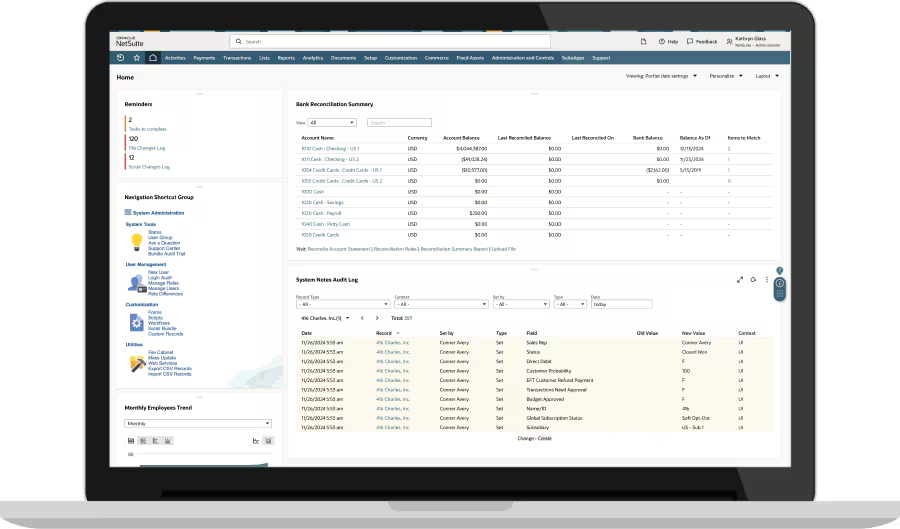
Tracking profitability across unit economics, gross margin, and cash burn gets difficult when financial data lives in multiple spreadsheets and disconnected tools. NetSuite Cloud Accounting Software brings general ledger, accounts receivable, accounts payable, and cash management into one system, with embedded AI that automates manual entry and speeds up the financial close. Real-time dashboards display profitability ratios, cash positions, and other key metrics as soon as transactions post, so founders don’t have to wait until the end of the month to see where the business stands. And built-in audit trails and support for GAAP’s ASC 606 and SOX compliance keep books audit-ready, which matters when it’s time to raise the next funding round or go public.
Manage Your Runway With NetSuite
Founders who track unit economics, gross margin, and cash burn from the earliest days make sure that the choice between growth and profitability will remain in their own hands, not left at the mercy of a tightening funding market. That discipline also protects a startup’s valuation, since investors increasingly price companies on profit rather than growth alone. AI is already taking over more of the manual work behind financial reporting and forecasting, and startups that adopt it early will likely reach profitability faster than those that wait. For early-stage companies seeking an accounting tool built specifically for startups, NetSuite's QuickStart delivers an AI-powered accounting platform of essential features. QuickStart brings automation to balance sheets, invoices, expenses, and more, giving startups a real-time look at key profitability metrics through a conversational interface connected to the AI you already use.
Tech Startup Profitability FAQs
How long does it take for a startup to become profitable?
How long it takes for a startup to reach profitability depends heavily on business model, spending discipline, and market conditions. Startups with strong capital efficiency from the start typically get there sooner.
When should a startup become profitable?
A startup should aim to become default alive—meaning, it could survive on its own cash flow—as early as its competitive strategy allows. Companies without a genuine network effect—where a product gets more desirable as more people use it—or other structural advantage should prioritize profitability early to keep the company’s future in the founders’ hands.
How can I improve profitability for my startup?
Startups can improve profitability by fixing negative unit economics, pricing according to the value of their product, and avoiding projects that drain resources without offering a clear return.