
An insurance agency’s books don’t operate like an ordinary ledger. Premiums flow through customer accounts, but most of that money is held in trust until it’s remitted to the carrier. Commissions can shift after a sale. And carrier payments rarely line up neatly with when the business was written. All the while, state regulators are watching how every dollar is handled.
Fortunately, growing agencies can rely on specialized insurance accounting software to get the features that matter most. But to choose the right system, decision-makers must carefully weigh each platform’s capabilities—and the vendor behind it—to single out which one best suits the type of insurance they handle.
What Is Insurance Accounting Software?
Insurance accounting software is a financial management system built for the way agencies and brokerages handle money, layering insurance-specific workflows on top of standard accounting rules. For example, general accounting software can record simple debits and credits, but it will likely struggle with the line-by-line reconciliations that agencies require to separate pass-through premiums and keep their books compliant.
This software can stand alone or come built into a configured insurance ERP application.
Key Takeaways
- A large share of the money an insurance agency handles belongs to carriers; clean books keep those funds segregated.
- Purpose-built software automatically separates client, carrier, and producer funds.
- Each insurance line—life, health, property and casualty, or commercial—carries its own accounting rules and requires adaptable software.
- When comparing vendors, factors like industry fit, compliance support, security, and long-term costs are often more important than the initial price tag.
- Unified accounting software brings companywide benefits, including AI’s ability to use that centralized financial data for deeper analytics and automation.
Insurance Accounting Software Explained
Insurance accounting must clearly delineate between agencies—which sell and service policies for a commission—and carriers, which issue the policies, take on the risk, and net the premium. For most insurance agencies, a sizable share of collected premiums goes to the carrier through one of two transaction pathways. Under the agency bill model, premiums flow through the agency on their way to the carrier. In direct bill, carriers invoice clients directly and pay the agency its commission after collecting premiums. Agency-billed funds are fiduciary money, held in trust for the carrier in a separate account from operating funds. Back-office insurance processes that commingle these dollars may violate insurance regulations and put an agency’s license at risk.
Insurance accounting software separates trust balances from operating cash. It ties each premium to the appropriate policy and carrier, so the agency can see how much of its cash really belongs to someone else. As with other businesses, insurance companies’ financial statements must comply with Generally Accepted Accounting Principles (GAAP). Yet most carriers in the US have an additional compliance layer: statutory accounting principles. These rules, set by the National Association of Insurance Commissioners (NAIC), are more conservative than GAAP. Accounting software built for insurance maintains both sets of books simultaneously, automatically syncing data to avoid manually rebuilding the same numbers under two different rule books.
Why Is Cloud-based Accounting Software Important for Businesses?
Each insurance line keeps its books differently, for both the carriers that underwrite the risk and the agencies that sell the policy. A cloud accounting platform offers two main benefits: First, it can be configured for a specific line’s reserve and revenue rules without requiring extensive onsite IT infrastructure or expertise. Second, it lets everyone work from the same live data to secure a concurrent view of operations. Various insurance lines benefit from a cloud-based digital transformation in the following ways.
Life Insurance
Life insurance is a long-duration business. Premiums come in for years or decades against benefits that may not be paid until far in the future, so accounting takes place as gradual revenue recognition over the contract’s life. Cloud software can model long horizons to preserve the accuracy of reserves from one period to the next and maintain statutory and GAAP treatments side by side so teams don’t rebuild the same statements by hand under two rule books.
Health Insurance
Health insurance runs on high transaction volumes and constantly moving claims amid a tight regulatory environment. Agency billing adds complexity, as agencies collect premiums from employers, group plans, and individual policyholders, then transfer money to the carriers that underwrite the policy. The carriers, in turn, face their own reporting burdens, such as the medical loss ratio set by the US Affordable Care Act, which requires insurers to spend at least 80% of premiums paid on care and quality improvement. The difference is rebated to policyholders. Cloud platforms can adjust to transaction volume and generate both the required regulatory filings and the ad hoc reports for internal analyses.
Property and Casualty (P&C)
P&C insurance focuses on a combination of long- and short-term financials, with two figures at the center of accounting: unearned premiums collected before a policy’s start date and loss reserves for future or unsettled claims. Both figures move constantly, and a single peril, such as a major storm or earthquake, can have big implications for both. Cloud software recalculates earned premium and updates reserves as events happen, giving agencies an up-to-date read on underwriting results.
Commercial Insurance
Commercial insurance accounting can get complicated quickly. For example, a single agency client might carry several policies from multiple carriers across state lines, with premiums financed and audited or adjusted after the policy goes live. That creates commission splits and multistate tax-handling issues that many simple ledgers can’t maintain without extensive manual effort. Cloud accounting software ties every transaction back to the specific policy and producer who sold the policy, allowing a midterm audit or endorsement to update every affected policy and producer cleanly.
The Benefits of Cloud Accounting Software for Insurance Agencies
The immediate payoff from purpose-built cloud software shows up in quantifiable ways, such as a faster period close and fewer errors. It also shows up more subtly, such as when a finance team member gets plain-language answers to auditors’ questions from generative AI tools trained on the agency’s data. The following benefits often justify an insurance business’s decision to switch accounting systems:
- Better compliance support: Trust-accounting rules and audit trails built into workflows make sure accounts remain segregated, so when examiners ask for records, they’re already there. That lessens the chance of mistakes that may lead to violations or reputational damage.
- Reduced manual errors: Automated data entry and reconciliation cut out the rekeying that leads to errors. At the same time, AI-based document detection can scan invoices and carrier statements and enter the figures directly into the system.
- Increased productivity: Automatically calculating commissions and setting up recurring premium billing gives staff more time to chase down disputed carrier statements or outstanding premium payments.
- Enhanced reporting: Live dashboards display the real-time key performance indicators that insurance agencies rely on, from commissions and trust balances to loss ratios and revenue per policyholder. AI can also use this data to explain what’s feeding those metrics.
- Improved cash flow visibility: Because premium receivables and commission payables sit in the same ledger, an agency owner can see what’s collectible and what’s owed, then weigh current cash against upcoming forecasts, without stitching reports together by hand.
- Faster reconciliations and closes: Bank feeds and automated reconciliation speed the close, so leaders get fresh numbers while they’re still useful.
9 Critical Accounting Software Features for Insurance Agencies
Not every platform labeled “for insurance” covers the same ground. These nine capabilities separate software that can genuinely run an agency’s books from a generic solution with an insurance logo slapped on the login screen.
-
General Ledger
The general ledger is the backbone every other function reports into, giving the software’s built-in analytics and AI one complete record to work from. For insurance, the ledger must treat multiple entities and trust accounts natively, so the boundaries between fiduciary and operating funds don’t blur.
-
Accounts Payable (AP) and Accounts Receivable (AR)
Agencies owe carriers and collect from clients, and these transactions rarely happen at the same time. Automating AP and AR keeps carrier payables, client receivables, expense tracking, and producer commissions up to date, and agency owners know what’s coming in and what’s going out with enough visibility to forecast cash flow. Even after premiums are collected, further adjustments may be necessary as policies get canceled or renewed. For example, NAIC has rules for how midterm policy changes affect premiums; software can automatically calculate the return premium owed, reverse any commission already booked against it, and document the adjustment so records are consistent.
-
Tax Management and Tax Reporting
Insurance has unique tax rules that general-purpose software may not be able to handle, such as taxes on premiums or surplus lines owed in specific regions. In California, for instance, an insurance broker placing coverage with a non-admitted carrier owes a 3% surplus-lines tax on that premium, filed with the state annually. Software that calculates each obligation by jurisdiction and produces the appropriate filings verifies that agencies are compliant, thus avoiding any penalties for missed deadlines or misfiled statements.
-
Automation Support
Automation touches nearly every capability accounting software provides. For example, automated reconciliation for commissions matches carrier statements against expected commissions, while accounting for splits, overrides, and payments that arrive late or short. Beyond rule-based automation, platforms with embedded AI agents can monitor financial transactions and act within preset permissions, closing out clean matches and marking exceptions for human review.
-
Integration Capabilities
Accounting software that integrates an agency’s key business information sources—the agency management system, carriers’ data, policy rules, the agency’s bank accounts—often under one insurance ERP platform, minimizes manual data imports and improves accuracy. That connection means a policy sold in one system doesn’t have to be re-entered in another to be paid for or booked, so it’s less likely that anything will fall through the cracks. The connection to claims systems matters, too. When approved claims flow straight into the ledger, finance can access true numbers and forecasts when they need them, without chasing down pending reports.
-
Payment Management
Money moves in several directions at an agency: Premiums come in from clients, then head back out to carriers and producers. Software that manages the full payment lifecycle records and reconciles every inflow and outflow in one place. AP teams rely on this visibility to time outgoing payments to be sure the agency has enough cash on hand to meet obligations as they come due. Even a profitable stretch can strain cash flow when clients pay late, so that timing matters.
-
Multi-Book Accounting
Insurance companies are often required to keep at least two distinct sets of books—statutory and GAAP—but they may run additional sets for tax, international, or internal reporting purposes. Multi-book accounting features allow software to maintain each book using a single set of transactions, so the same activity is reported correctly under each standard without doubling or tripling the time and labor.
-
Bulk Invoice Generation
Renewals and recurring premiums mean the same invoices go out on a schedule, often by the hundreds, and some clients’ accounts may not change for months or years at a time. Batch invoice processing generates and sends them in one run, replacing a full day of billing with automated workflows and a few minutes of work.
-
Financial Reporting
Agencies answer to owners, carriers, regulators, and other stakeholders, each of whom seeks a different view of the company’s finances. Insurers must also follow NAIC’s reporting schedule—a statutory annual statement filed by March 1, as well as quarterly statements that are due throughout the year. Insurance-focused reporting software can produce statutory filings, plus internal management reports with performance metrics, such as insurance agent productivity or book-of-business profitability. Regular internal reporting helps agencies improve operations and monitor progress.
Evaluating Accounting Software for Your Insurance Agencies: 8 Criteria
Choosing the right software vendor goes faster with the help of an objective scorecard. These eight criteria help insurance agencies separate software that can bring real returns from software that merely demos well:
- Compliance: Confirm that candidates can support the agency’s trust accounting and statutory reporting obligations. The system also needs to supply audit trails that satisfy examiners’ requirements.
- Security and data protection: Clients’ financial and personal data is a common target for cybercriminals, so look for effective data governance—strong encryption, role-based access controls, and support for SOC 2 compliance. Before committing to a vendor, understand where data will be stored and who can access it.
- Vendor support: Consider post-launch support, including length of response times and the availability of human support staff with accounting expertise in case the software isn’t working as expected.
- Vendor expertise: A vendor that knows insurance won’t need your business to explain trust accounting or surplus lines during configuration or service calls. When workflows reflect how agencies actually bill and book commissions, workers are more likely to use it, so the software will pay off faster.
- Ease of use: Accountants and producers will likely use the accounting software every day; a straightforward interface can help them quickly find what they need. Clunky software leads to workarounds, hidden errors, and slower adoption.
- Total cost of ownership (TCO): Budget considerations go beyond the price tag to include implementation, training, and any integrations and add-ons that may arise over the next few years. These additional costs should be factored when calculating TCO, though the right insurance ERP can offset them through efficiency and accuracy gains.
- Industry-specific support: Prebuilt insurance functionality spares teams the tedium of bending a generic tool, which can lead to overlooked flaws and faulty data sharing. In most cases, the less custom work an agency needs, the lower the cost and the fewer support issues down the line.
- Customization and scalability: The right system grows with the agency, able to add new lines and states, as well as absorb new acquisitions over time. Extensive customization on day one can increase a system’s cost and complexity, though modular systems are designed with adding new features and AI capabilities in mind, without necessitating any major overhauls as the business expands.
Have You Outgrown Your Insurance Accounting Software?
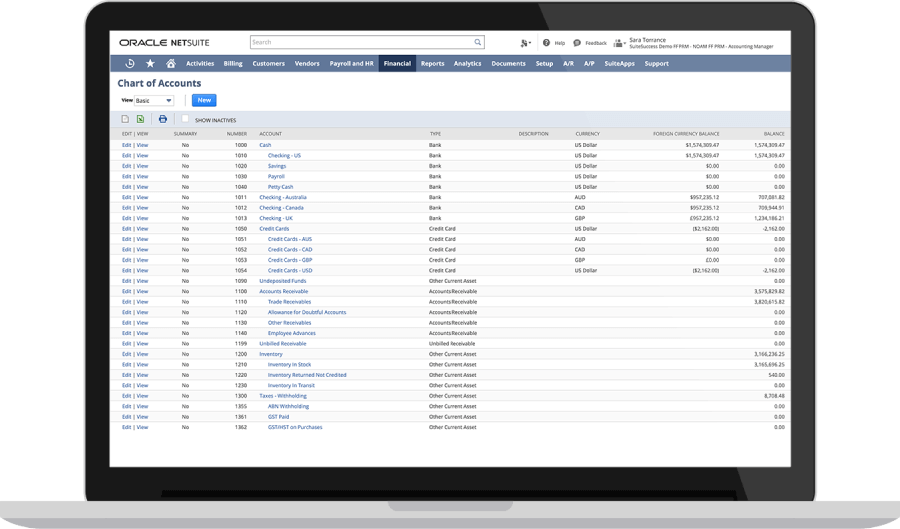
The time to replace accounting software isn’t always obvious. Rather than passing an explicit threshold, agencies slowly begin to struggle, whether from trouble adding new lines, acquisitions that strain the system, or slipping compliance. NetSuite Accounting Software for Insurance Agencies runs premiums, payouts, commissions, and integrated claims data on one ledger that handles multi-entity, multi-book, and multicurrency accounting aligned with both statutory accounting standards and GAAP. Built-in AI adds anomaly detection that scans transactions for unusual variances, plus invoice capture that reads carrier statements into the system. Meanwhile, AI agents, such as Autonomous Close, work through reconciliations and note exceptions for human review. NetSuite gives the financial team the up-to-date data it needs to manage cash flow and bookkeeping via one role-based dashboard.
NetSuite’s Accounting Dashboard
The right accounting software doesn’t make an insurance agency’s compliance and trust complexities disappear. But it certainly replaces the finance team’s end-of-period scrambles with routine automation and real-time transparency. Even the best system can reach its potential only when it supports how the agency actually bills and earns, which usually requires a platform created with the insurance industry in mind. For an agency expanding into new states or planning an acquisition, the difference between having a purpose-built system and a generic accounting tool becomes painfully obvious year after year. It’s worth choosing a system that can keep up.
Insurance Accounting Software FAQs
Can accounting software help with insurance compliance?
Insurance-specific software supports requirements that general tools aren’t built for, such as segregating trust funds and producing statutory reports. However, compliance outcomes still depend on how an agency configures and uses the system, so the vendor’s capabilities and support options matter.
How much does accounting software cost insurance companies?
Pricing varies widely, with solutions ranging from basic bookkeeping tools to cloud-based insurance ERPs that come with implementation and add-on costs. For most companies, total cost of ownership is about more than the monthly price; it includes setup, training, expected downtime during implementation, and integration with legacy systems that will stay in place after go-live.